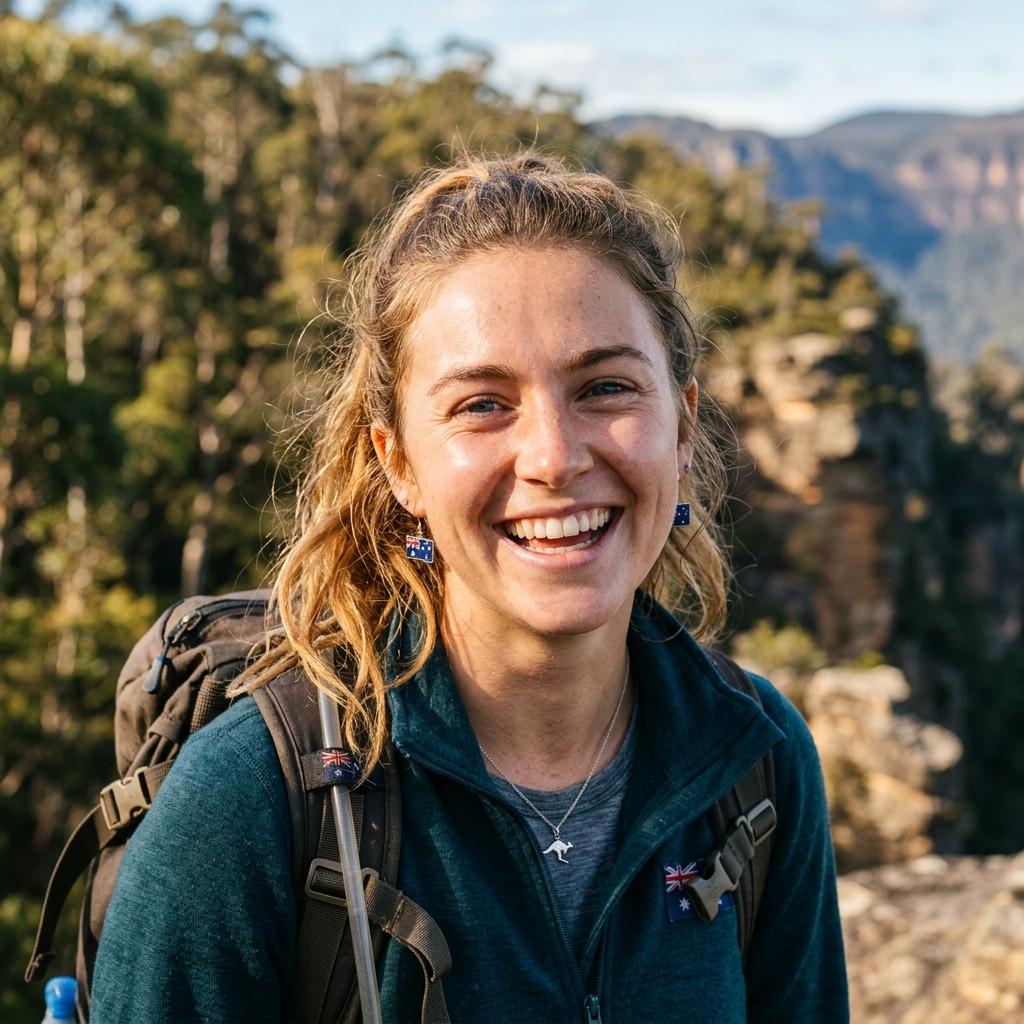
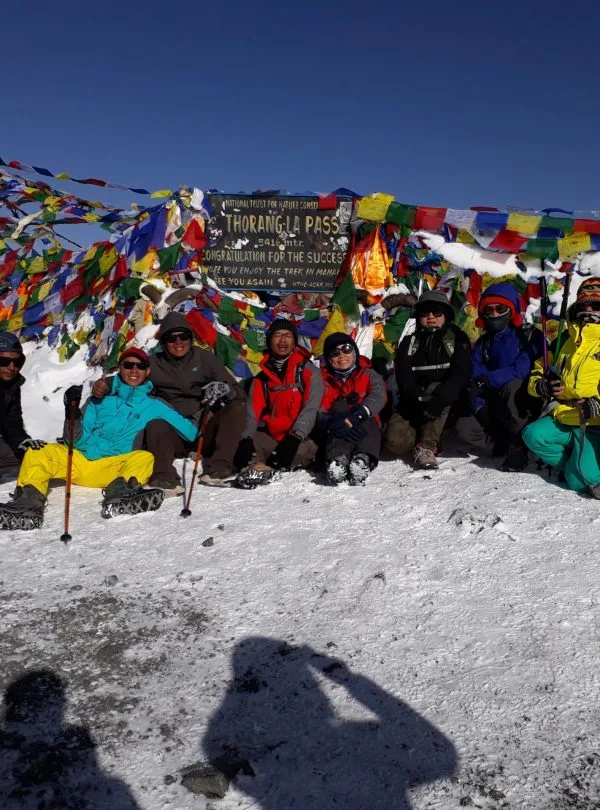
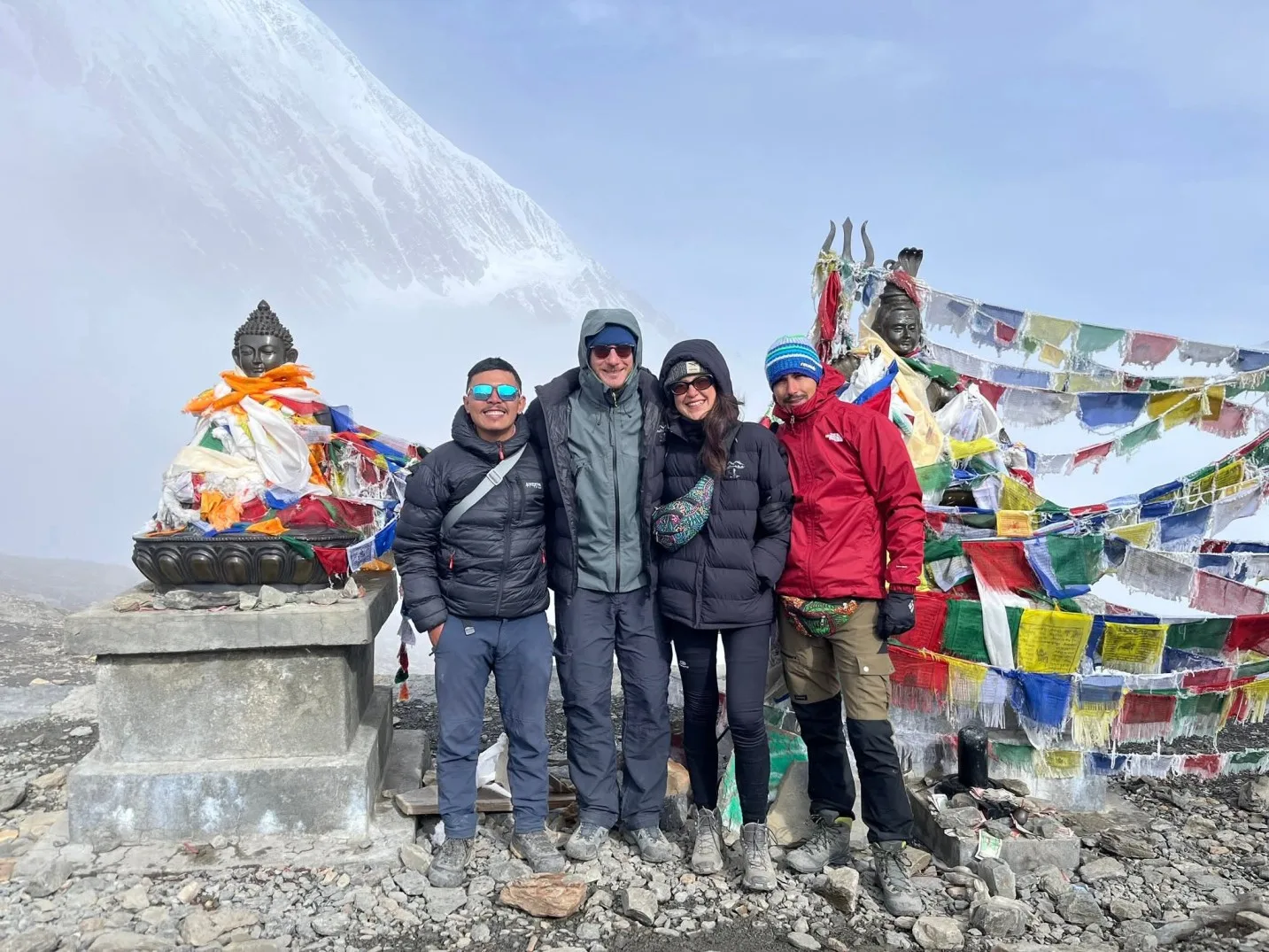
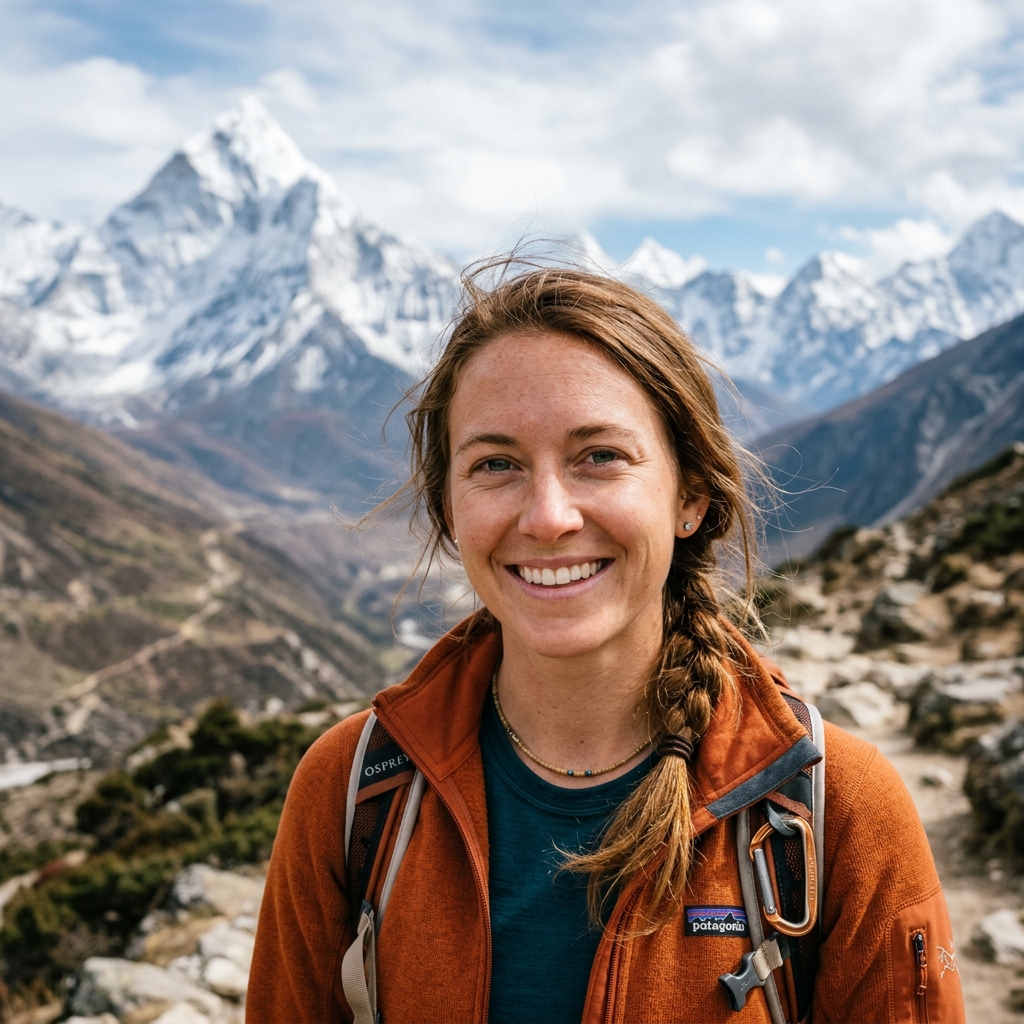
Our 17-day Classic Annapurna Circuit trek with Igloo Himalaya Treks went beyond every expectation we had! What first pulled us towards them was their strict safety protocol and personal care. From the scenic high trail via Upper Pisang and Ngawal to our acclimatisation day in Manang and crossing Thorong La Pass (5,416m) at sunrise, Sagar and the team made sure we were comfortable, safe, well-acclimatized, and hydrated every single day! Soaking our weary legs in the natural hot springs of Tatopani and watching the dawn light hit Dhaulagiri from Poon Hill completed the most breathtaking Himalayan adventure of our lives.
Annapurna Region • 17 Days Classic Grand Circuit
5.0
reviews on TripAdvisor
5.0
169 reviews on Google
Classic Annapurna Circuit Trek — 17 Days
Follow the longer Annapurna Circuit through Manang, over Thorong La and onwards to Poon Hill on our 17-day trek. You’ll walk through Upper Pisang and Ngawal before an acclimatisation day in Manang, then cross the 5,416-metre pass to Muktinath.
Travelers' Choice
Best of the Best 2026
Key Trip Facts
Duration
17 days, including arrival, departure, road travel and one acclimatisation day
Difficulty
Moderate to challenging
Maximum Altitude
Approximately 5,416 m at Thorong La Pass
Destination
Nepal
Activity
Trekking
Accommodation
3-star hotels in Kathmandu and Pokhara; teahouses along the trekking route
Transport
Ground transfers to Jagat, from Birethanti to Pokhara and back to Kathmandu; airport transfers
Meals
Breakfast in Kathmandu and Pokhara; three meals during the trek; breakfast and lunch on Day 15
Recommended Season
Spring (March–May) and autumn (September–November)
Trek Starts
Jagat
Trek Ends
Birethanti
Trek Region
Annapurna
Package Start Point
Kathmandu
Package End Point
Kathmandu
Classic Annapurna Circuit Trek Overview
Our 17-day Classic Annapurna Circuit Trek follows the Marsyangdi Valley to Manang, crosses Thorong La at 5,416 m and continues through the Kali Gandaki Valley. Beyond Muktinath, you walk through Marpha, Ghasa and Tatopani before climbing to Ghorepani. The sunrise hike to Poon Hill brings views of the Annapurna and Dhaulagiri ranges in clear weather.
After driving from Kathmandu to Jagat, you follow riverside paths through Dharapani and Chame. Forested slopes and waterfalls give way to the higher villages of Upper Pisang, Ghyaru and Ngawal. This approach to Manang takes the higher trail, where prayer walls and stone houses reflect local Buddhist traditions. A second night in Manang gives you time for a shorter acclimatisation hike before you continue towards the high pass.
After Thorong La, the walk descends to Muktinath and continues through Jomsom to Marpha. Apple orchards and village lanes give the journey a different character from the exposed pass approach. You continue through Ghasa to Tatopani, where a visit to the hot springs is possible, before the sustained climb towards the forested ridge at Ghorepani.
This longer itinerary includes thirteen walking days, counting the Manang acclimatisation hike. The lower valley stages still involve substantial distances, while the climb from Tatopani to Ghorepani comes after several days of descent. You need endurance for uphill and downhill walking. Technical climbing skills are unnecessary in suitable conditions, but altitude, weather and the long pass crossing require careful preparation.
You stay in mountain teahouses during the trek and three-star hotels in Kathmandu and Pokhara. The programme covers arrival, the full walking route, return road travel and departure.
Key Route Highlights & Destinations
Thorong La Pass (5,416 m)
Poon Hill (3,210 m)
Manang Valley (3,550 m)
Muktinath Temple (3,800 m)
Tatopani Hot Springs (1,190 m)
Marpha Apple Orchards (2,580 m)
Thorong La High Pass Crossing
Marshyangdi to Kali Gandaki Valleys
Sunrise over Annapurna & Dhaulagiri
Licensed High-Altitude Mountain Guides
Want to know more about this trek?
Chat with us — real trekking experts, not bots.
Replies within 6–7 hours
Classic Annapurna Circuit Trek Highlights
The signature landmarks, cultural stops and mountain viewpoints along our 17-day grand circuit route:
Cross Thorong La Pass (5,416 m)
Cross Thorong La at 5,416 m, linking the Manang Valley with Mustang before the long descent to Muktinath on the western side.
Marpha's Stone Lanes & Apple Orchards
Walk through Marpha’s stone-paved lanes, where whitewashed houses and apple orchards reflect the village’s Thakali heritage.
Tatopani Natural Hot Springs
Continue through Ghasa to Tatopani, with greener valley trails and the option of visiting natural hot springs.
Climb towards Ghorepani Ridge
Climb from Tatopani through hillside villages and forest to Ghorepani, preparing for sunrise hike.
Poon Hill Sunrise Himalayan Panorama
Hike to Poon Hill for sunrise views of the Annapurna and Dhaulagiri ranges when skies clear.
Two Nights & Acclimatisation in Manang
Spend two nights in Manang, combining a shorter acclimatisation hike with rest before continuing towards Yak Kharka and Thorong Phedi.
Why Book the Classic Annapurna Circuit Trek with Igloo Himalaya Treks?
We help you prepare in Kathmandu and support your journey through the Annapurna region. This package includes the following arrangements.
Trek Briefing and Preparation
Before leaving Kathmandu, we explain the walking programme and preparations for the pass. You can ask questions about equipment, accommodation and the Manang acclimatisation day during your arrival briefing.
Guide and Porter Support
Your package includes a licensed, English-speaking guide and one porter for every two trekkers. Your guide leads the route and explains local landmarks, while your porter carries your main trekking bag.
Equipment Provided for the Trek
We provide a sleeping bag, down jacket and duffel bag for use during the trek. Return these after the journey, and bring your own boots, clothing and other personal trekking equipment.
Communication When Plans Change
Weather and road conditions can affect the approach, pass crossing and return travel. Our team explains available options and discusses changes with you, including extra accommodation or transport costs outside the programme.
Day 1: Arrival in Kathmandu
Overnight: Kathmandu
Overnight altitude: Kathmandu, around 1,350 m
Accommodation: 3-star hotel in Kathmandu
Meals: Breakfast
Welcome to Nepal. Our representative meets you at Tribhuvan International Airport and accompanies you to your Kathmandu hotel. After settling in, we discuss the trekking programme, the high pass crossing and your preparations before leaving the city.
Depending on your arrival time, you can walk around Thamel, organise your belongings or rest after the flight. Ask us about any equipment questions before tomorrow’s road journey into the Annapurna region.
Day 2: Drive from Kathmandu to Jagat
Approximately 7–8 hours • Approx. 215 km • Overnight: Jagat
Driving time: Approximately 7–8 hours, depending on road conditions
Driving distance: Approximately 215 km
Overnight altitude: Jagat, around 1,310 m
Accommodation: Teahouse in Jagat
Meals: Breakfast, lunch and dinner
We leave Kathmandu after breakfast and drive towards the Marsyangdi Valley, travelling through Besisahar before continuing to Jagat. The journey takes much of the day, with stops along the way.
The road passes riverside towns and terraced hillsides before reaching narrower valley roads. Traffic, roadworks or rain can affect the driving time, so treat the schedule as approximate. At Jagat, we check into a teahouse and prepare for tomorrow’s walk. Keep a warm layer and personal essentials accessible during the journey, with your luggage packed.
Day 3: Trek from Jagat to Dharapani
Approximately 5–6 hours • Approx. 13 km • Overnight: Dharapani
Walking time: Approximately 5–6 hours
Trek distance: Approximately 13 km
Overnight altitude: Dharapani, around 1,855 m
Accommodation: Teahouse in Dharapani
Meals: Breakfast, lunch and dinner
Our first trekking day follows the Marsyangdi Valley through Chamje and towards Tal. Forested paths, waterfalls and river crossings introduce the lower section of the circuit before Dharapani.
The trail includes uphill stretches and uneven steps, so we settle into a pace that allows regular breaks. Beyond Tal, the route continues through villages towards Dharapani, where the Annapurna and Manaslu walking routes meet. Once we reach our teahouse, the afternoon gives you time to rest and organise your daypack for the climb to Chame.
Day 4: Trek from Dharapani to Chame
Approximately 5–6 hours • Approx. 14 km • Overnight: Chame
Walking time: Approximately 5–6 hours
Trek distance: Approximately 14 km
Overnight altitude: Chame, around 2,670 m
Accommodation: Teahouse in Chame
Meals: Breakfast, lunch and dinner
We continue up the valley through mountain villages and pine forest, gaining height towards Chame. Timang is a useful stop along the route, with views towards Manaslu when the weather allows a clear view.
The day combines steady climbs with gentler stretches as the air becomes cooler. Chame is the headquarters of Manang District, with lodges and shops along the river. After reaching the teahouse, you can rest or take a short walk around the town.
Day 5: Trek from Chame to Upper Pisang
Approximately 4–5 hours • Approx. 14 km • Overnight: Upper Pisang
Walking time: Approximately 4–5 hours
Trek distance: Approximately 14 km
Overnight altitude: Upper Pisang, around 3,300 m
Accommodation: Teahouse in Upper Pisang
Meals: Breakfast, lunch and dinner
Leaving Chame, we follow the Marsyangdi upstream through pine forest and beneath steep rock walls. The curved rock face of Paungda Danda marks a section before the valley opens towards Pisang.
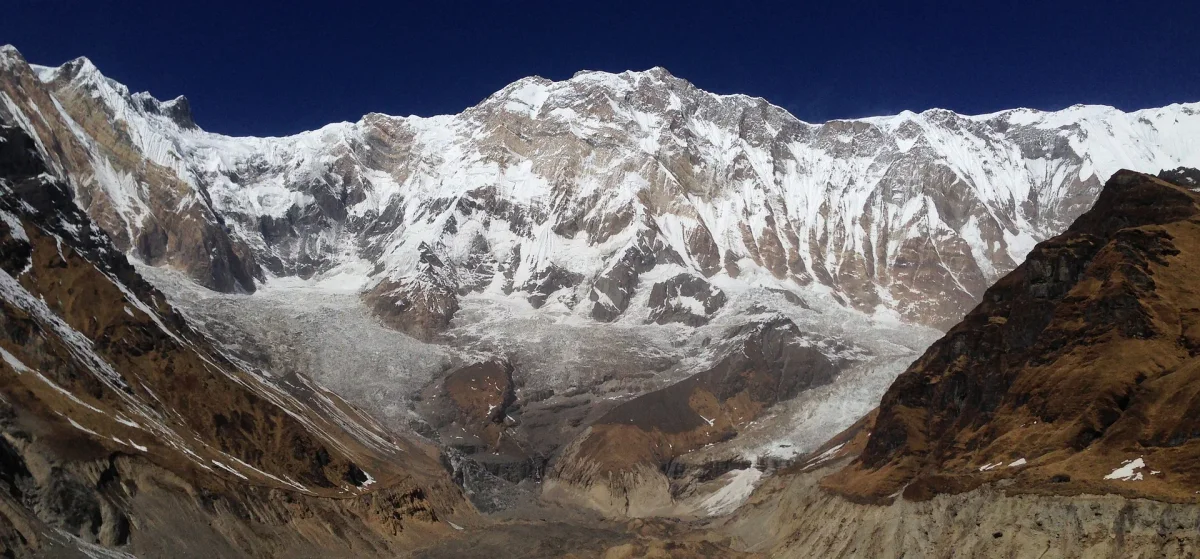
We continue to Upper Pisang, above the lower village, where stone houses and a monastery face the mountains. Clear weather can reveal Annapurna II and Pisang Peak. Today takes us above 3,000 m, so notice how you feel and tell your guide about any symptoms before settling into the teahouse.
Day 6: Trek from Upper Pisang to Manang via Ngawal
Approximately 6–7 hours; the higher route may take longer • Approx. 19 km • Overnight: Manang
Walking time: Approximately 6–7 hours; the higher route may take longer
Trek distance: Approximately 19 km
Main route: Upper Pisang–Ghyaru–Ngawal–Manang
Overnight altitude: Manang, around 3,550 m
Accommodation: Teahouse in Manang
Meals: Breakfast, lunch and dinner
We take the higher trail from Upper Pisang through Ghyaru and Ngawal. The climb brings wider views across the Marsyangdi Valley, with Annapurna’s peaks visible when the cloud clears from the mountains above the villages.
Prayer walls and stone buildings line sections of this village route. After Ngawal, we continue towards Manang, where we stay for two nights. This is a substantial walking day with climbs and descents; take breaks and report symptoms rather than pushing to keep up.
Day 7: Acclimatisation Day in Manang
Approximately 3–4 hours • Overnight: Manang
Walking time: Approximately 3–4 hours
Hike options: Gangapurna Lake or nearby viewpoints, subject to conditions
Overnight altitude: Manang, around 3,550 m
Accommodation: Teahouse in Manang
Meals: Breakfast, lunch and dinner
We stay another night in Manang and take a shorter acclimatisation hike around the valley. Gangapurna Lake and nearby viewpoints are possible options, with the outing chosen according to conditions and how everyone is feeling.
After the hike, we return to the same teahouse for the night. The remaining time is for rest and preparation before continuing higher. Tell your guide about headaches, nausea or unusual fatigue, even if the symptoms seem mild to you.
Day 8: Trek from Manang to Yak Kharka
Approximately 3–4 hours • Approx. 11 km • Overnight: Yak Kharka
Walking time: Approximately 3–4 hours
Trek distance: Approximately 11 km
Overnight altitude: Yak Kharka, around 4,045 m
Accommodation: Teahouse in Yak Kharka
Meals: Breakfast, lunch and dinner
Leaving Manang, we follow the route towards Yak Kharka, gaining height above the valley. The trees gradually give way to open grazing slopes and smaller clusters of lodges. Our overnight stop is around 4,045 m above sea level.
The distance is shorter than the approach to Manang, but altitude makes walking feel harder. We keep a measured pace and allow time for breaks. On arrival, rest at the teahouse and prepare warm layers for the colder evening ahead.
Day 9: Trek from Yak Kharka to Thorong Phedi
Approximately 3–4 hours • Approx. 8 km • Overnight: Thorong Phedi
Walking time: Approximately 3–4 hours
Trek distance: Approximately 8 km
Overnight altitude: Thorong Phedi, around 4,445 m
Accommodation: Teahouse in Thorong Phedi
Meals: Breakfast, lunch and dinner
We continue from Yak Kharka towards Thorong Phedi, our overnight base before the pass crossing. The path follows exposed slopes, with the higher mountains increasingly close above the valley.
Although the walking distance is relatively short, the altitude demands a steady pace. Keep clear of loose ground and follow your guide’s instructions on narrow sections. We reach the teahouse with time to prepare for tomorrow.
Pack your headlamp, warm gloves and weather protection where you can reach them easily. Rest after dinner and discuss how you feel before the early departure tomorrow.
Day 10: Cross Thorong La Pass and Trek to Muktinath
Approximately 8 hours; snow • Approx. 15 km • Overnight: Thorong La Pass
Walking time: Approximately 8 hours; snow, weather and pace can extend the crossing
Trek distance: Approximately 15 km
Highest point: Thorong La Pass, approximately 5,416 m
Overnight altitude: Muktinath area, around 3,800 m
Accommodation: Teahouse in the Muktinath area
Meals: Breakfast, lunch and dinner
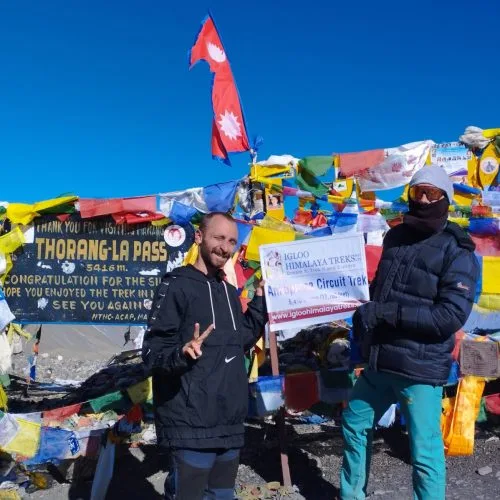
We leave Thorong Phedi before dawn and climb towards Thorong La. The ascent reaches 5,416 m, the highest point of the itinerary. Thin air, cold and exposed ground make this demanding; the guide adjusts progress to conditions and your health.
After a brief stop at the pass, we begin the long descent towards Muktinath. The trail loses considerable height before reaching the pilgrimage area, which is important to Hindus and Buddhists. Once at the teahouse, rest after the crossing rather than planning strenuous activity.
Day 11: Trek from Muktinath to Marpha
Approximately 5–6 hours • Approx. 22 km • Overnight: Marpha
Walking time: Approximately 5–6 hours
Trek distance: Approximately 22 km
Main stop: Jomsom
Overnight altitude: Marpha, around 2,580 m
Accommodation: Teahouse in Marpha
Meals: Breakfast, lunch and dinner
We leave Muktinath and descend towards Jomsom through the dry hills of Mustang. The trail reaches the Kali Gandaki Valley before continuing south towards our overnight stop at Marpha.
This is a long walking stage, with some stretches following the road. Allow for breaks and be prepared for wind along the valley. Marpha has whitewashed houses, stone-paved lanes and apple orchards. After reaching the teahouse, you can explore the village or rest following the descent from the higher mountains.
Day 12: Trek from Marpha to Ghasa
Approximately 6–7 hours • Approx. 26 km • Overnight: Ghasa
Walking time: Approximately 6–7 hours
Trek distance: Approximately 26 km
Overnight altitude: Ghasa, around 2,040 m
Accommodation: Teahouse in Ghasa
Meals: Breakfast, lunch and dinner
We continue south through the Kali Gandaki Valley, passing Tukuche and Larjung on the way towards Ghasa. The route loses altitude overall, with more trees and farmland appearing along the valley.
The distance makes this a substantial day even though we finish lower than we started. Walking includes village paths and sections beside the road, with climbs between descents. Forest returns as the valley becomes greener. Once in Ghasa, settle into the teahouse and rest before tomorrow’s continued descent towards Tatopani.
Day 13: Trek from Ghasa to Tatopani
Approximately 5–6 hours • Approx. 19 km • Overnight: Tatopani
Walking time: Approximately 5–6 hours
Trek distance: Approximately 19 km
Overnight altitude: Tatopani, around 1,190 m
Accommodation: Teahouse in Tatopani
Meals: Breakfast, lunch and dinner
Leaving Ghasa, we follow the lower Kali Gandaki Valley towards Tatopani. The walk passes forested hillsides and villages, with warmer conditions as we lose height after the upper circuit.
Uneven steps and long downhill stretches can feel tiring after several days on the trail. At Tatopani, check into the teahouse and take time to rest. The village is known for its natural hot springs; you can ask about visiting them, with entry costs confirmed before deciding whether to go.
Day 14: Trek from Tatopani to Ghorepani
Approximately 6–7 hours • Approx. 18 km • Overnight: Ghorepani
Walking time: Approximately 6–7 hours
Trek distance: Approximately 18 km
Overnight altitude: Ghorepani, around 2,860 m
Accommodation: Teahouse in Ghorepani
Meals: Breakfast, lunch and dinner
We leave Tatopani and climb towards Ghorepani, gaining substantial height after the descent through the Kali Gandaki Valley. The trail passes hillside villages and terraced farmland before entering the forest above.
Expect sustained uphill walking, including stone steps, rather than an easy approach. Rhododendron forests can flower during spring, while the higher trail becomes cooler as you approach Ghorepani. At the teahouse, organise your headlamp and warm layers for tomorrow’s sunrise hike, then have dinner and rest before the early start.
Day 15: Poon Hill Sunrise, Trek to Birethanti and Drive to Pokhara
Approximately 6 hours • Overnight: Poon Hill
Walking time: Approximately 6 hours, depending on the route and pace
Driving time: Approximately 1.5 hours from Birethanti to Pokhara
Highest point: Poon Hill, approximately 3,210 m
Overnight altitude: Pokhara, around 850 m
Accommodation: 3-star hotel in Pokhara
Meals: Breakfast and lunch
Before dawn, we climb from Ghorepani to Poon Hill at 3,210 m. In clear weather, sunrise brings views across the Annapurna and Dhaulagiri ranges. We pause at the viewpoint before returning to Ghorepani for breakfast and preparing for the descent.
Our final trekking stage continues downhill through forest and villages towards Birethanti. The descent still requires care on steps and uneven ground. After lunch, we complete the walk and drive to Pokhara, where your hotel is arranged. Dinner is at your own expense tonight.
Day 16: Drive from Pokhara to Kathmandu
Approximately 6–7 hours • Approx. 203 km • Overnight: Kathmandu
Driving time: Approximately 6–7 hours, depending on road conditions
Driving distance: Approximately 203 km
Overnight altitude: Kathmandu, around 1,350 m
Accommodation: 3-star hotel in Kathmandu
Meals: Breakfast
After breakfast in Pokhara, we travel by road towards Kathmandu. The journey follows river valleys and hillside roads, with stops along the way depending on the driving conditions.
Traffic, roadworks or rain can make the journey longer than expected. Once in Kathmandu, check into your hotel and use the remaining time for rest or a walk around Thamel. Lunch and dinner are at your own expense today.
Day 17: Final Departure from Kathmandu
Departure from Nepal and airport transfer
Main activity: Departure from Nepal and airport transfer
Meals: Breakfast
Your 17-day Classic Annapurna Circuit Trek ends today. After breakfast, prepare for your onward journey and check your belongings. Depending on your flight time, you may have time for a final walk before leaving Kathmandu.
Our representative accompanies you to Tribhuvan International Airport for your departure.
Not satisfied with this Itinerary?
Are you interested on planning custom trip? It only takes 2 minutes.
What’s Included in the Classic Annapurna Circuit Trek
Airport transfers
Pickup and drop-off for your arrival and departure in Kathmandu.
Ground transport
Scheduled road journeys from Kathmandu to Jagat, Birethanti to Pokhara and Pokhara back to Kathmandu after trekking.
Accommodation
Two nights in a 3-star Kathmandu hotel, one night in a 3-star Pokhara hotel and thirteen teahouse nights along the route, including two in Manang.
Meals
Breakfast in Kathmandu and Pokhara; breakfast, lunch and dinner from Jagat to Ghorepani, with tea or coffee and fresh fruit at dinner. Day 15 includes breakfast and lunch only.
Guide and porter
A licensed, English-speaking trekking guide and one porter for every two trekkers.
Permits and documentation
Required Annapurna trekking permits and agency paperwork, including conservation area entry and TIMS registration arrangements.
Trekking equipment
Use of a sleeping bag, down jacket and duffel bag during the trek, with items returned after the journey.
First-aid supplies
A comprehensive medical kit carried by your trekking guide throughout.
Emergency coordination
Helicopter evacuation arrangements if required. Evacuation costs are excluded.
Trip extras
A detailed trekking map, completion certificate, government taxes and official service charges.
What’s Not Included
International flights and Nepal visa
Airfare to and from Nepal and your visa fee.
Travel insurance
The cost of insurance covering high-altitude trekking, medical treatment and emergency helicopter evacuation costs.
Emergency evacuation
Helicopter rescue and other evacuation costs, requiring suitable insurance cover or separate personal payment.
Personal equipment
Boots, clothing and other personal trekking items beyond the sleeping bag, down jacket and duffel bag provided.
Extra food and drinks
Drinking water, snacks, desserts and beverages purchased beyond the included meals, fruit and tea or coffee.
City lunches and dinners
Kathmandu and Pokhara meals beyond the breakfasts in the itinerary.
Teahouse services
Hot showers, Wi-Fi and device charging fees.
Guide and porter tips
Gratuities for your trekking team.
Additional accommodation or transport
Extra costs may apply when delays, itinerary changes or personal extensions require services outside the programme.
Classic Annapurna Circuit Trek Dates & Availability
Group Departures: If you would like to trek with other travellers, ask us about upcoming group departures. We’ll confirm the available dates, spaces and price for your chosen departure.
Private Trek Dates: Prefer to travel with your own group? Send us your preferred arrival date and number of travellers. We’ll check the arrangements for a private trek.
Starting Prices by Group Size
Prices are supplied by quotation. Send us your preferred dates and group size so we can confirm availability, included services and the total package cost. Ask us about your preferred dates.
1 Person (Solo)
USD 1,385
Private Support
2–4 People
USD 1,285
Small Group
5–9 People
USD 1,195
Group Savings
10–20 People
USD 1,175
Best Value
Other Group Sizes
Quote
Request Quote
05
MAR
Mar 5 – Mar 21, 2026
AVAILABLE$1,175 pp
18
MAR
Mar 18 – Apr 3, 2026
AVAILABLE$1,175 pp
What to Pack for the Classic Annapurna Circuit Trek
We provide a sleeping bag, down jacket and duffel bag in Kathmandu.
Printable Checklist
Pack layers for warmer valley walking, cold mornings and nights, and possible snow near Thorong La. Keep water, warm clothing, rain protection, medicines and valuables in your daypack. Use the supplied duffel bag for belongings carried by the porter.
Hiking Gear
Clothing
A down jacket is supplied for your use during the mountain trekking days.Sleeping Equipment
Toiletries & Hygiene
Electronics
Documents & Personal Items
We also provide a duffel bag. Ask us about essential equipment in Kathmandu before departure. Keep your passport, money and electronics with you in your own daypack.
0/10 read
Click topics below to explore essential briefings
Trek Difficulty and Fitness
The Classic Annapurna Circuit does not require technical climbing skills in suitable conditions, but it is demanding. You walk on consecutive days over uneven ground, with long descents and steep climbs. Thorong La reaches 5,416 m, while the lower valley stages can involve substantial daily distances.
Previous hiking experience is helpful. First-time trekkers should build endurance before departure and become comfortable walking uphill and downhill regularly with a daypack.
Begin preparing around two to three months beforehand, allowing longer if you are starting from a low fitness level. Gradually combine regular walks, hill hikes and strength exercises. Practise in the boots you will wear on the trek.
Altitude and Acclimatisation
We spend two nights in Manang, with a shorter hike on Day 7 before continuing higher. This allows time to adjust, although altitude illness remains possible during the ascent.
Tell your guide promptly about headaches, nausea, dizziness or unusual fatigue. Do not continue to a higher sleeping altitude while experiencing symptoms of altitude illness. If symptoms worsen despite resting at the same elevation, descent is necessary. Reaching Thorong La must remain secondary to your health.
Medical Conditions and Travel Insurance
If you have an existing medical condition, seek advice from a healthcare professional familiar with high-altitude travel before booking. Discuss your planned route and any medicines you take.
Arrange travel insurance covering trekking to at least 5,416 metres, emergency helicopter evacuation and medical treatment in Nepal. Check exclusions, excess charges and the insurer’s emergency assistance procedure beforehand. Carry your policy details and emergency contact number during every stage of the trek.
Accommodation and Room Facilities
You stay in three-star hotels in Kathmandu and Pokhara, with breakfast included, and teahouses throughout the walking route. The package covers sixteen overnight stays, including two nights in Manang for acclimatisation.
Expect basic rooms and shared bathroom facilities at Yak Kharka and Thorong Phedi. Room arrangements vary between lodges; ask about your preferences before booking. Nights on the higher route can be cold, even during spring and autumn.
Food and Dietary Requirements
Three daily meals are included between Jagat and Ghorepani. Teahouse menus commonly offer dal bhat, noodles, potatoes, soups and other straightforward meals.
Tell us about allergies or dietary requirements before booking so we can discuss what can be arranged along the route. Explain strict requirements clearly, including any concerns about shared cooking equipment.
Drinking Water
Carry reusable bottles and drink boiled or appropriately treated water. Stream water and untreated tap water may still contain germs that cause illness.
Boiling is the most reliable way to kill germs. If boiling is unavailable, filtration followed by disinfection offers broader protection than many portable filters alone. Follow the instructions for your water-treatment equipment or tablets.
Guide and Porter Support
The package includes a licensed, English-speaking guide and one porter for every two trekkers. Your porter carries the main trekking luggage; you carry your daypack with water, weather protection, medicines and daily essentials.
Showers, Charging and Communication
Hot showers, Wi-Fi and device charging cost extra, with availability varying between lodges. Mobile reception and internet connections can be unreliable, particularly around Yak Kharka and Thorong Phedi. Carry a power bank and let family know that you may be out of contact during trekking stages.
Permits and Documents
We arrange the required Annapurna Conservation Area permit and agency-issued TIMS registration for the trek. Carry your passport, insurance details and copies of important documents. Your Nepal visa fee remains separate from the package and permits.
Road Delays and Extra Time
Rough roads, roadworks and heavy rain can delay the transfers to Jagat or from Pokhara. Allow flexibility around return travel before your international departure.
Snow, wind or poor visibility can affect the Thorong La crossing. Changes to the schedule may require extra accommodation or transport beyond the package.
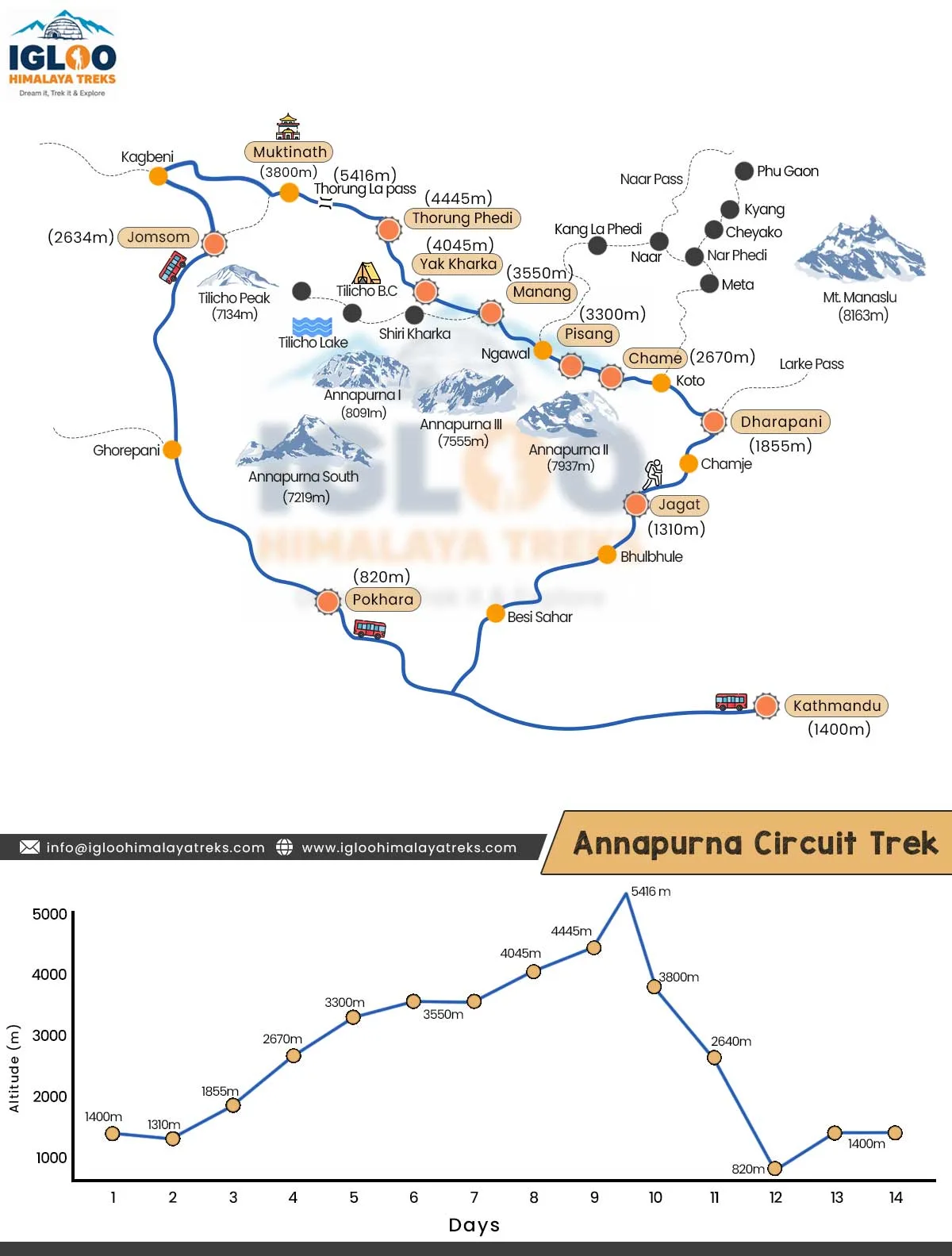
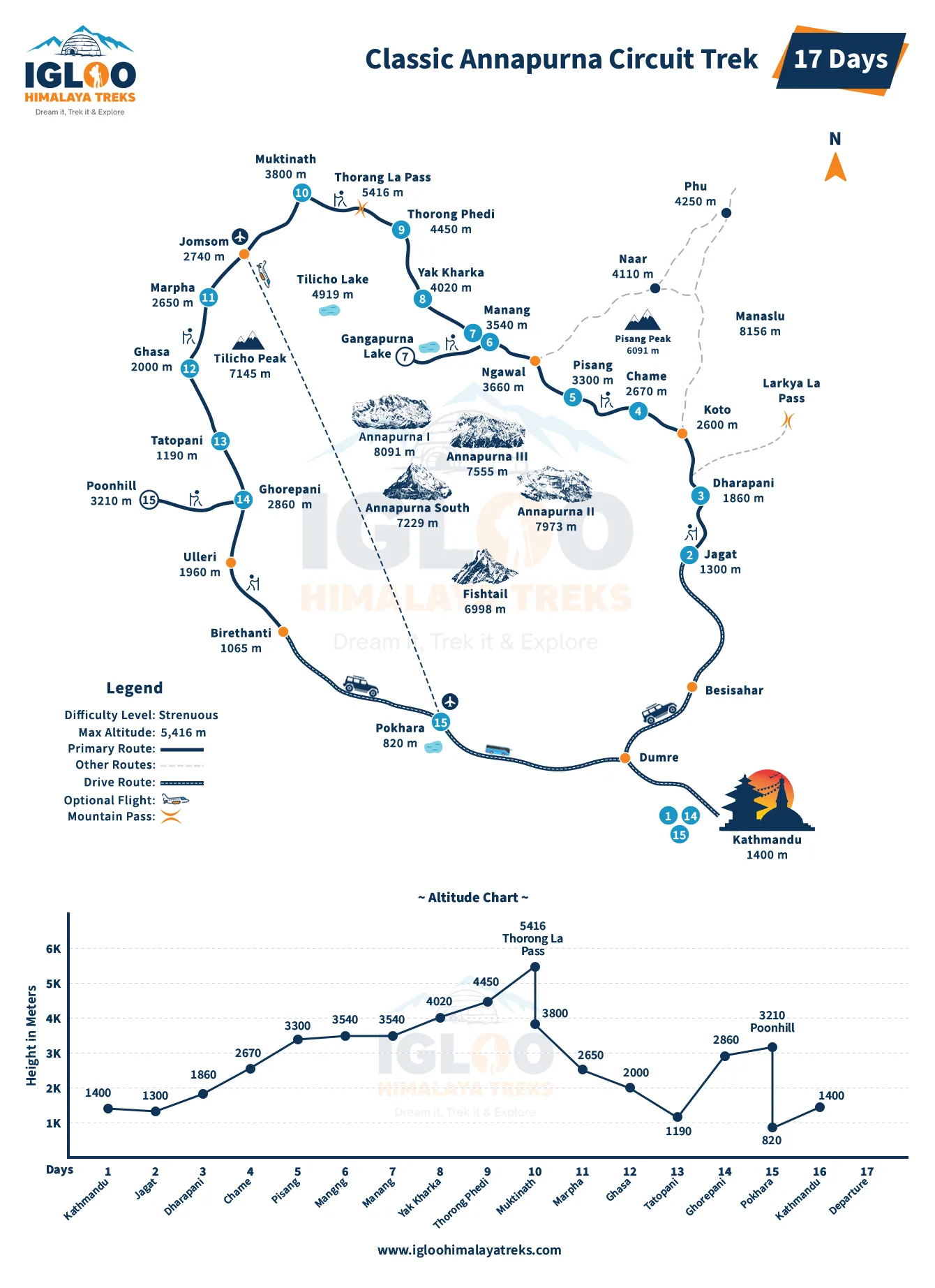
Altitude Profile of the Classic Annapurna Circuit Trek
The route climbs from Jagat through Upper Pisang to Manang, then continues towards Thorong Phedi before the Thorong La crossing. After descending through Muktinath, Marpha and Tatopani, you climb again to Ghorepani. Poon Hill is a daytime viewpoint before the descent and transfer to Pokhara.
Overnight Altitudes
| Day | Overnight Stop | Approximate Altitude |
|---|---|---|
| Day 1 | Kathmandu | 1,350 m |
| Day 2 | Jagat | 1,310 m |
| Day 3 | Dharapani | 1,855 m |
| Day 4 | Chame | 2,670 m |
| Day 5 | Upper Pisang | 3,300 m |
| Day 6–7 | Manang | 3,550 m |
| Day 8 | Yak Kharka | 4,045 m |
| Day 9 | Thorong Phedi | 4,445 m |
| Day 10 | Muktinath area | 3,800 m |
| Day 11 | Marpha | 2,580 m |
| Day 12 | Ghasa | 2,040 m |
| Day 13 | Tatopani | 1,190 m |
| Day 14 | Ghorepani | 2,860 m |
| Day 15 | Pokhara | 850 m |
| Day 16 | Kathmandu | 1,350 m |
| Day 17 | Departure | No overnight stay |
Elevations are approximate and follow the overnight stops in our itinerary.
Higher Places You Visit
- • Day 6 — Ngawal route: A higher approach above the Marsyangdi Valley, before descending towards Manang.
- • Day 7 — Manang acclimatisation hike: Gangapurna Lake or nearby viewpoints, returning to Manang for the night.
- • Day 10 — Thorong La Pass: At 5,416 m, the trek’s highest point, before descending to Muktinath.
- • Day 15 — Poon Hill: Around 3,210 m, a sunrise viewpoint before the descent towards Birethanti.
Two nights in Manang allow acclimatisation before the pass approach. Thorong La and Poon Hill are daytime visits, followed by descent to lower overnight stops.
Weather and Best Time for the Classic Annapurna Circuit Trek
Spring, from March to May, and autumn, from September to November, are generally the best seasons for the Classic Annapurna Circuit. Both offer opportunities for mountain views, although rain, cloud, cold weather and snowfall remain possible, particularly around the exposed Thorong La pass crossing.
Seasonal Weather Conditions
| Season | Months | What to Expect |
|---|---|---|
| Spring | March–May | Lower valleys become warmer, with rhododendrons flowering on the Ghorepani approach. March can retain snow and ice near Thorong La. April often offers balanced conditions; May can bring haze, cloud and occasional showers. |
| Autumn | September–November | Early September can retain monsoon rain. October and November generally offer clearer views after the rains, with colder mornings around the high pass. Snowfall remains possible, especially later in November. |
| Winter | December–February | Cold, short daylight and snow or ice make the pass crossing more demanding. Heavy snow can prevent crossing Thorong La or change the itinerary. Lower valleys may be quieter, but the full route requires particular care. |
| Monsoon | June–August, sometimes extending into September | Rain affects the lower valleys and Ghorepani trails, with slippery paths, landslides and possible road delays. Manang and Mustang are relatively drier, but the full route still crosses wetter areas and an exposed high pass. |
These are seasonal patterns; conditions can vary from year to year and during an individual trek.
How Weather Changes Along the Route
The lower Marsyangdi Valley is warmer, with forested slopes beside the river. Conditions become colder and more exposed beyond Upper Pisang, especially during the approach from Manang towards Thorong Phedi.
After Muktinath, the Kali Gandaki Valley becomes warmer as you descend, though wind can still affect walking. Tatopani is much lower than the pass approach. The climb to Ghorepani brings cooler forest conditions before the early Poon Hill hike.
Which Season Should You Choose?
Choose spring if you would enjoy flowering forests around Ghorepani alongside the high pass journey. Choose autumn, particularly October or November, if mountain visibility is your priority. Winter and monsoon require greater flexibility around the crossing and lower valley trails.
Book the Classic Annapurna Circuit Trek
Send us your preferred travel dates, number of travellers and any questions about the trek. We’ll check availability and confirm the price and arrangements for your group. If you are unsure whether this itinerary suits your experience or fitness, tell us about your previous walking trips so we can discuss the programme together.
Group discounts apply automatically for 2 or more travellers.
Estimated Total
$2,350
($1,175 / person)
Best Himalayan Trekking Reviews
Over 15,000 adventure seekers have explored Everest, Annapurna, and Manaslu with Igloo Himalaya Treks.
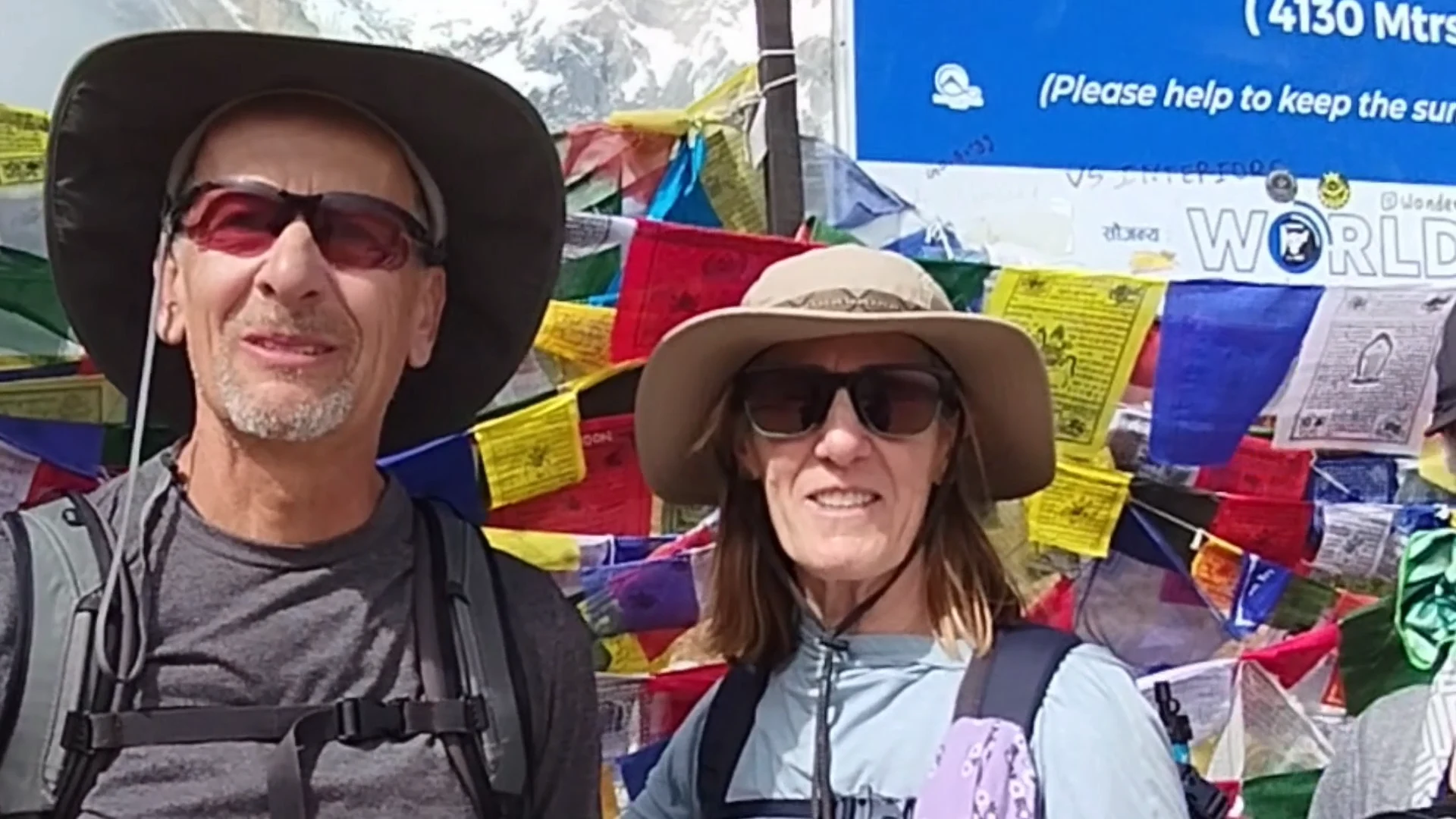
14 October
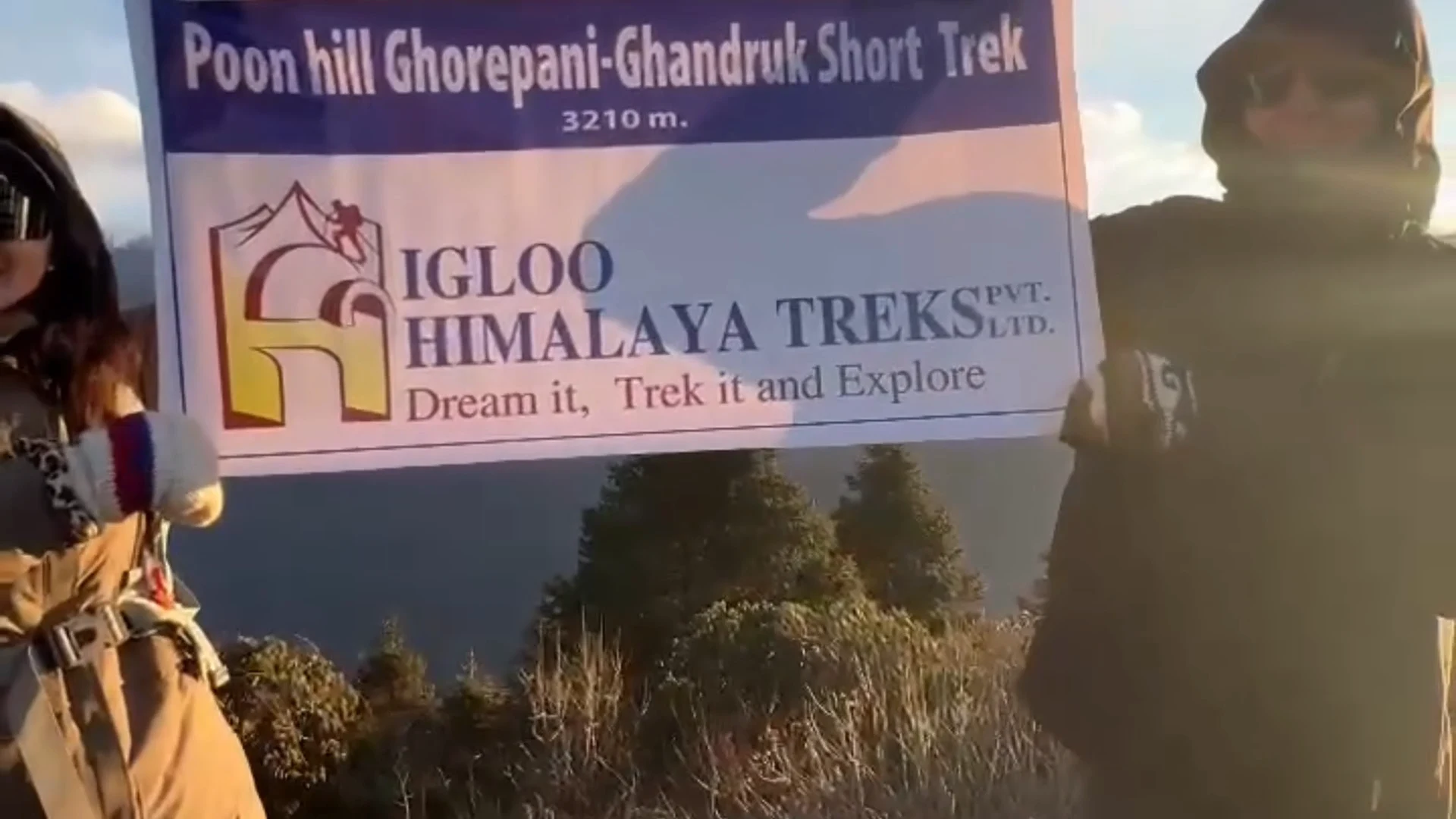
18 October
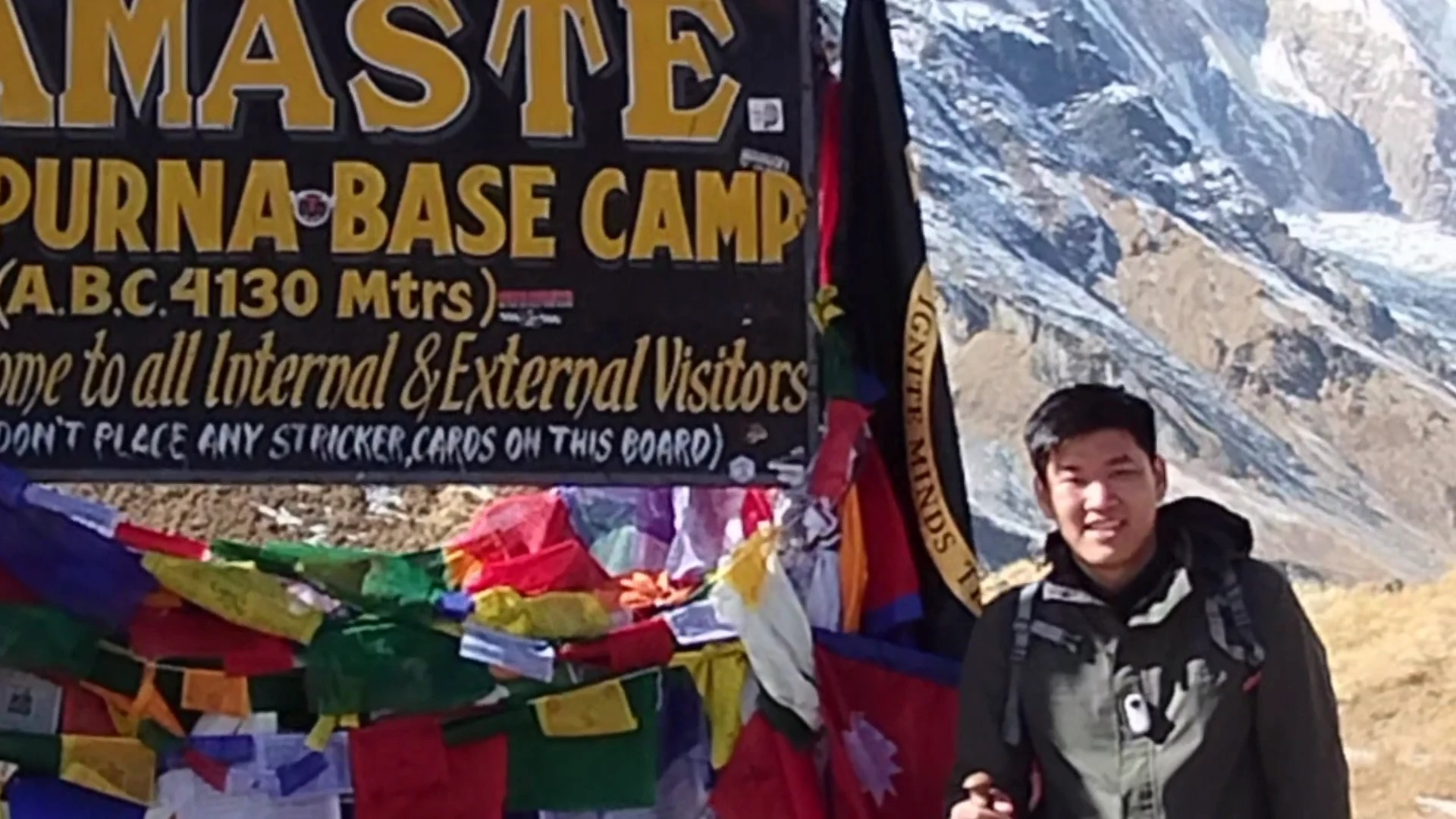
21 October
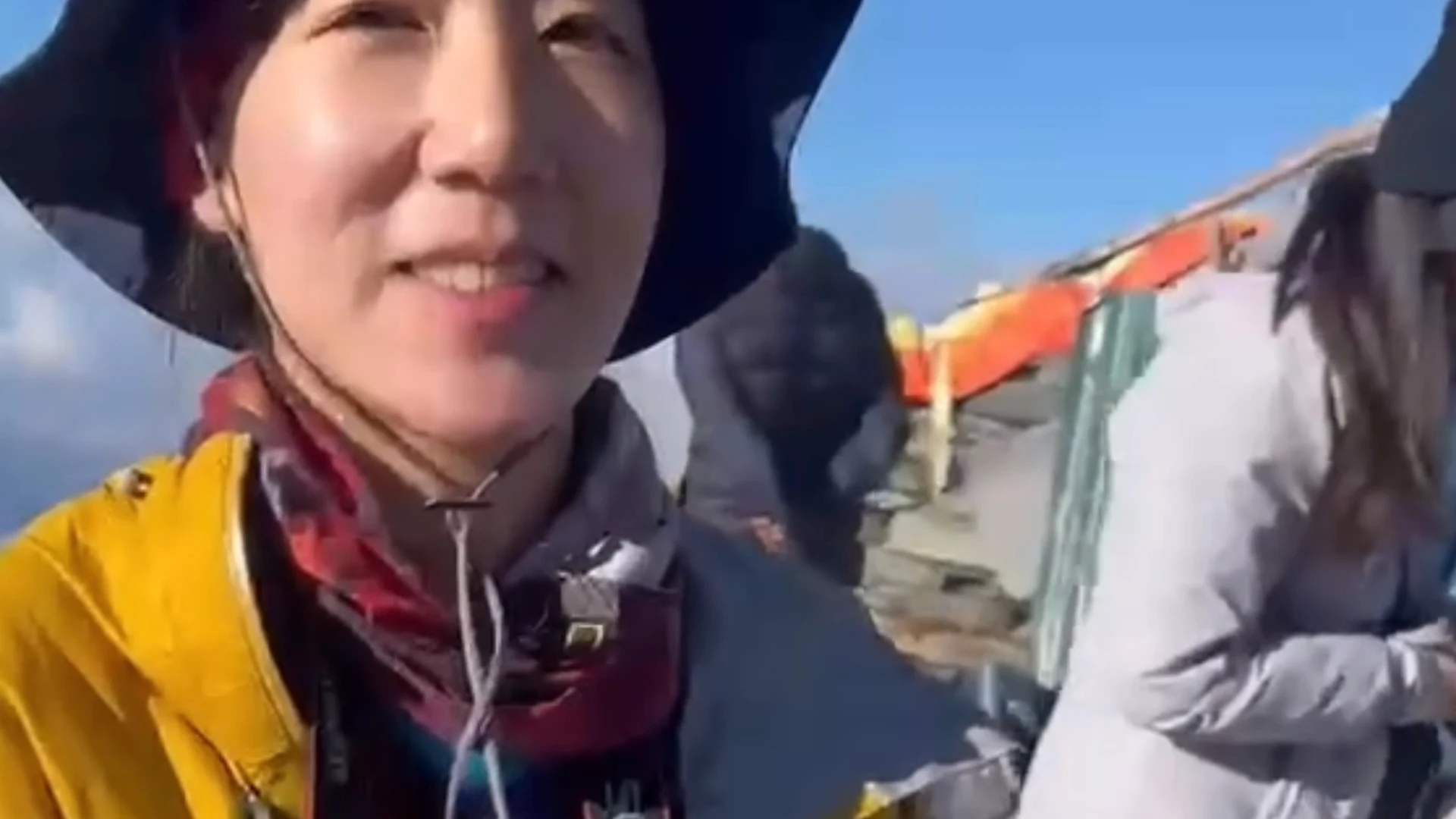
22 October
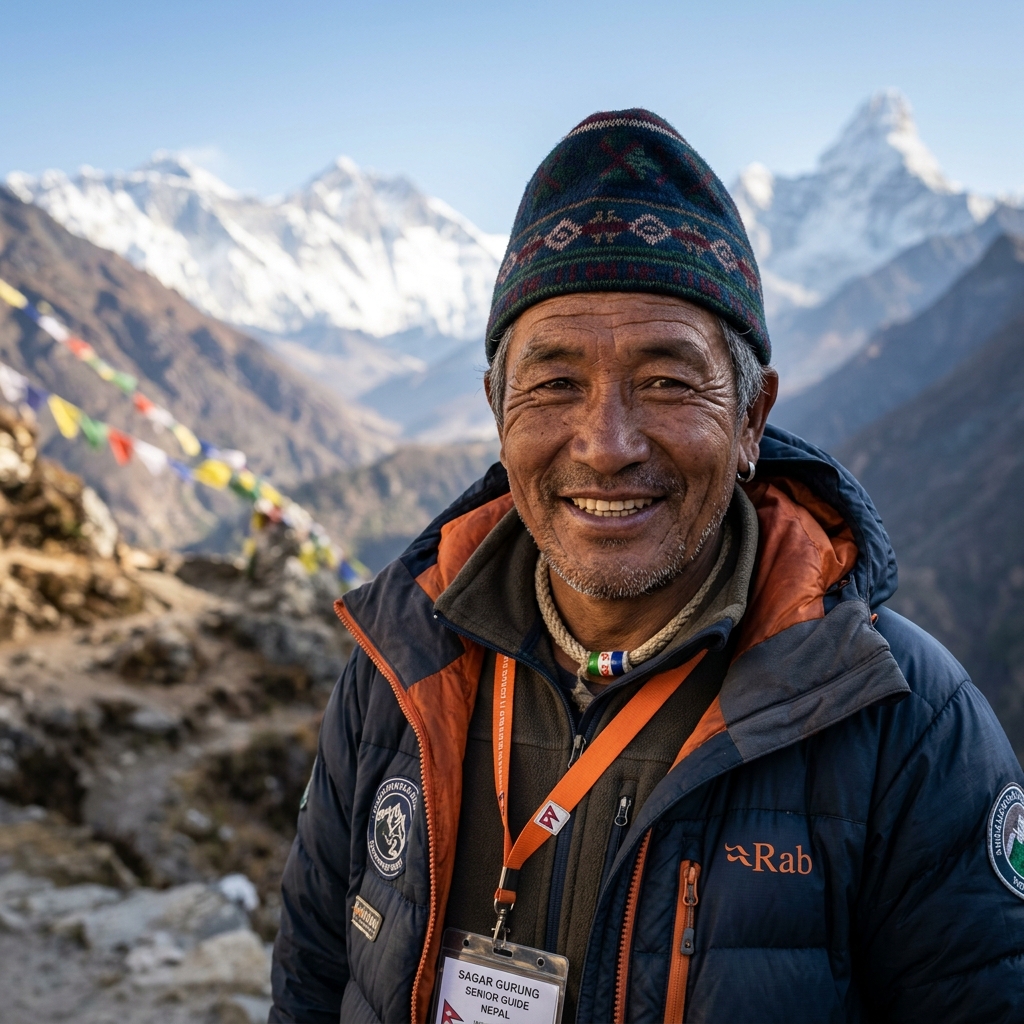 Guided by Sagar Gurung
Classic Annapurna Circuit Trek FAQs
General & Route
Can I do this trek without previous trekking experience?
∨
Hiking experience helps because the route includes consecutive walking days and a demanding high pass. First-time trekkers should prepare with hill walks and discuss fitness and altitude concerns before booking. Technical climbing skills are unnecessary in suitable conditions.
What is the highest altitude on this itinerary?
∨
Thorong La Pass at approximately 5,416 metres is the highest point. We cross it on Day 10 and descend to Muktinath afterwards. Thorong Phedi is the previous night’s base; we do not sleep at the pass.
Does this route include Poon Hill and Tilicho Lake?
∨
Poon Hill is included on Day 15, after the walk from Tatopani to Ghorepani. Tilicho Lake is not part of this itinerary. Our 18-day Annapurna Circuit with Tilicho Lake adds the lake visit before Thorong La.
Do we sleep at Thorong La Pass?
∨
No. You stay at Thorong Phedi on Day 9, cross the pass the following morning and descend to the Muktinath area for the night. The pass is a daytime high point, with the crossing dependent on conditions and health.
How does this differ from the 14-day Annapurna Circuit?
∨
The 14-day Annapurna Circuit finishes walking at Jomsom and returns to Pokhara by road. This 17-day Classic route continues through Marpha, Ghasa and Tatopani, climbs to Ghorepani and includes the Poon Hill sunrise hike before finishing the walk at Birethanti.
Are acclimatisation days complete rest days?
∨
No. The Manang day includes a shorter hike to Gangapurna Lake or nearby viewpoints before returning to the same teahouse. Your guide adjusts the outing to conditions and how you feel; report symptoms before starting.
Does being fit protect me from altitude sickness?
∨
No. Good fitness helps with the walking demands, but it does not prevent altitude illness. Fit and experienced trekkers can also become unwell. Follow your guide’s advice and report symptoms promptly instead of assuming fitness will protect you.
What should I do if I feel unwell at altitude?
∨
Tell your guide promptly about headaches, nausea, dizziness or unusual fatigue. Do not ascend to a higher sleeping altitude while experiencing symptoms of altitude illness. If symptoms worsen despite rest at the same elevation, descent is necessary.
Is insurance covering trekking to 5,500 metres sufficient?
∨
A 5,500-metre altitude limit covers the planned maximum of 5,416 metres, but altitude alone is insufficient. Confirm cover for this trekking route, emergency helicopter evacuation and medical treatment, including exclusions, policy limits and the insurer’s emergency assistance procedure.
Do I need to carry my main trekking bag?
∨
A porter carries your main trekking luggage, with one porter shared between two trekkers. You carry your daypack containing water, weather protection, medicines and other daily essentials. Keep your passport, money and valuables with you.
Do I need to bring a sleeping bag and down jacket?
∨
We provide a sleeping bag, down jacket and duffel bag for use during the trek. Return them afterwards. Bring your own boots, clothing and personal equipment, and ask about the supplied gear if you have particular requirements.
Can I book as a solo traveller?
∨
Yes. You can enquire about joining a group departure or arranging a private trek. Send us your preferred dates so we can check the available arrangements and confirm the price that applies to your booking.
MORE ADVENTURES
You Might Also Like
If you would prefer a shorter Circuit, a lake visit or a base camp journey, consider these Annapurna trekking packages.
 Challenging
14 DAYS
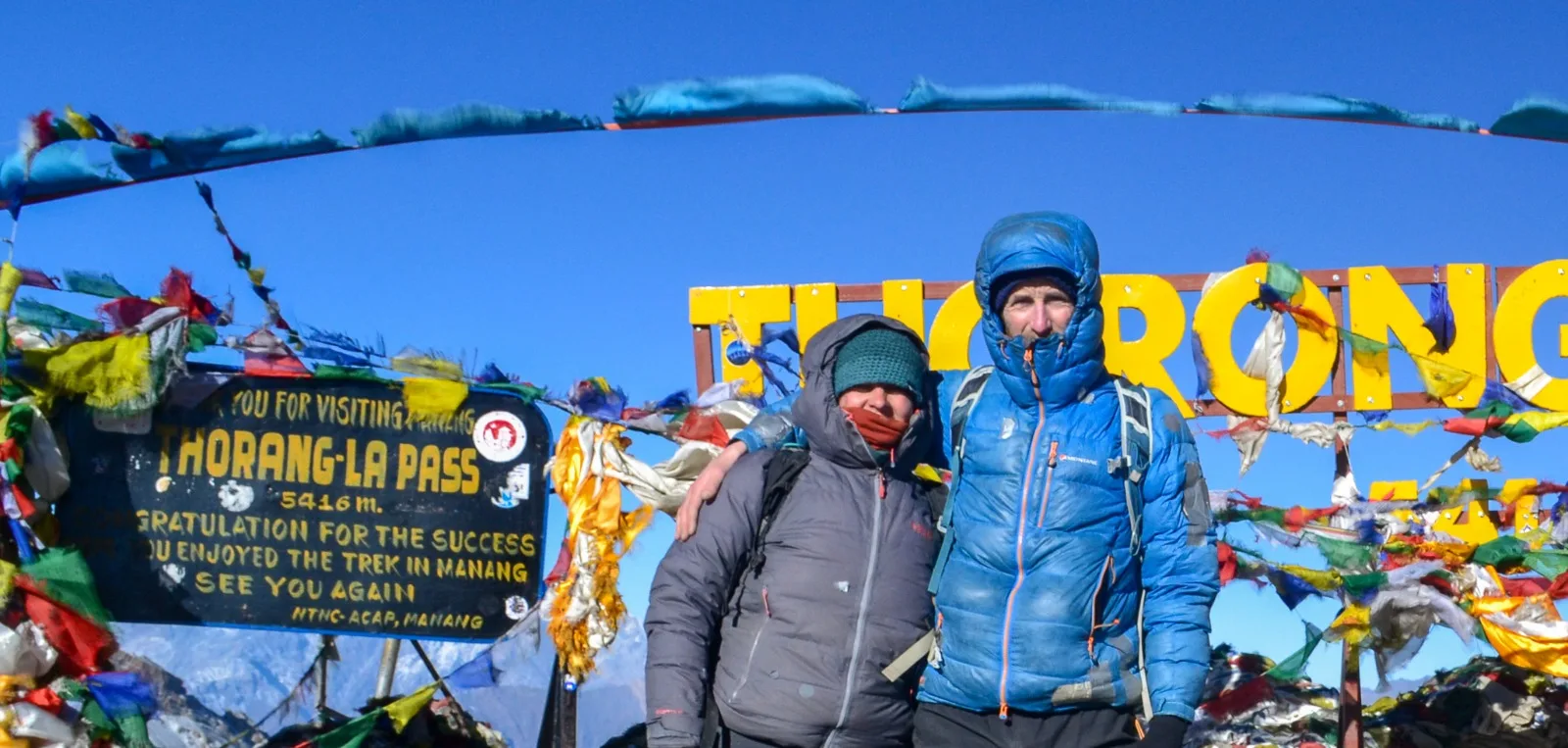
Annapurna Circuit Trek — 14 Days
Follow the Circuit through Manang and over Thorong La, then finish walking at Jomsom after visiting Kagbeni. Choose this shorter programme if your interest is the high pass without continuing towards Ghorepani and Poon Hill.
 Strenuous
18 DAYS
Annapurna Circuit with Tilicho Lake — 18 Days
Add the Tilicho Lake side trip to the Annapurna Circuit before crossing Thorong La. The longer programme includes additional mountain walking and overnight stops, with more time needed for the overall journey.
 Moderate
13 DAYS
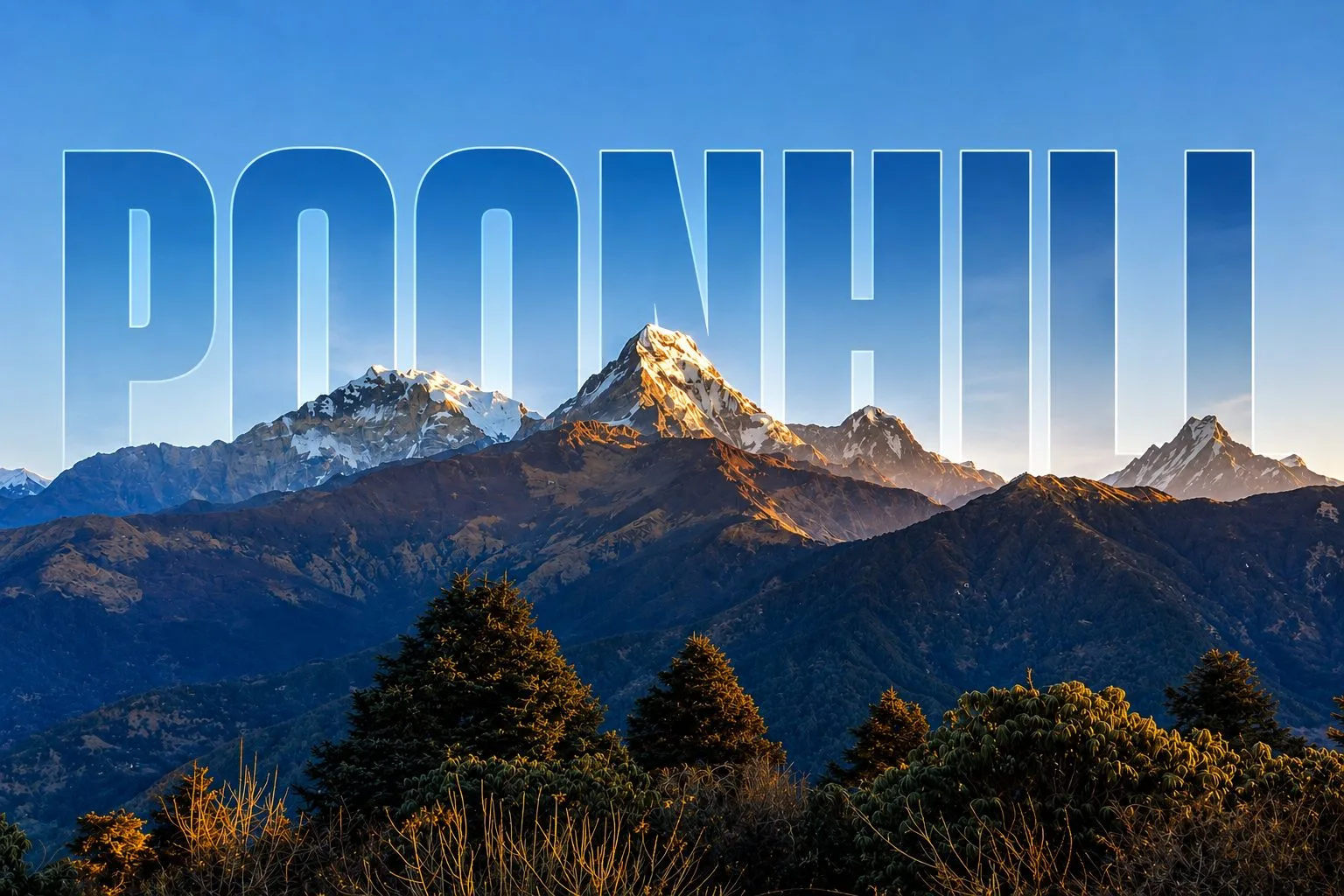
Annapurna Base Camp Trek via Poon Hill — 13 Days
Walk through Ghorepani and visit Poon Hill before continuing into the Annapurna Sanctuary. This route reaches Annapurna Base Camp at 4,130 m, with village trails and rhododendron forest walking, then descends through Bamboo and Jhinu Danda towards Pokhara.
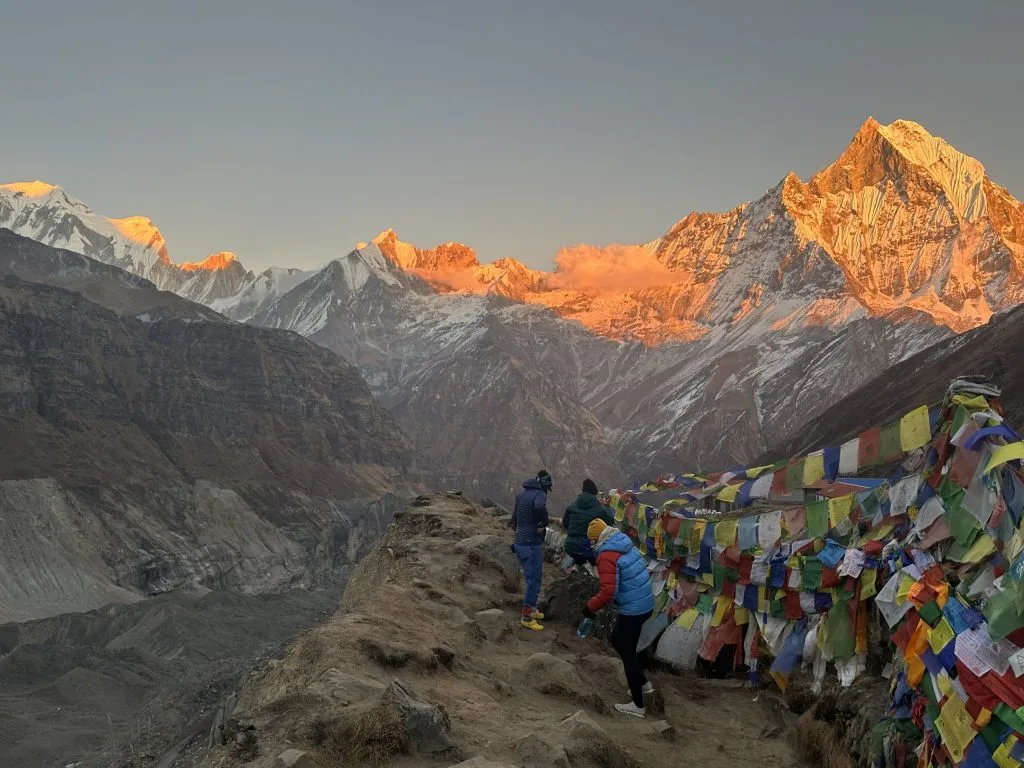 Moderate to Challenging
9 DAYS
Short Annapurna Base Camp Trek — 9 Days
Reach Annapurna Base Camp by the direct approach through Sinuwa, Deurali and Machhapuchhre Base Camp. This shorter programme includes five walking days and substantial sleeping-altitude gains, returning through Bamboo and Jhinu Danda before the drive to Pokhara.
Enquire about your preferred package for confirmed prices and availability.