1. Gokyo Lakes Difficulty Classification: Moderate to Strenuous High-Altitude Alpine Trek
In international alpine grading systems, the Gokyo Lakes trek is classified as a Grade 4 (Demanding / Strenuous) multi-day wilderness trek. It is distinctly more challenging than lower-altitude routes like Ghorepani Poon Hill or the Langtang Valley, yet considerably safer and less technically committing than full high-pass traverses such as the Everest Three Passes Trek.
The difficulty is not dictated by raw mileage—which averages a moderate 8 to 11 kilometers (5 to 7 miles) per day—but by four compounding environmental factors:
- Sustained Hypoxia: Spending six consecutive nights sleeping above 4,000 meters (13,100 ft), where oxygen molecules per breath are severely diminished.
- Steep Valley Gradients: Unlike the steady, gradual incline of the Khumbu Valley toward EBC, the Gokyo trail involves dramatic "rollercoaster" elevation drops and climbs between Mong La, Phortse Tenga, and Dole.
- Rugged Glacial Moraine: Walking on shifting boulder fields, loose gravel scree, and frozen mud along the lateral moraine of the Ngozumpa Glacier.
- Sub-Zero Alpine Climate: Nighttime temperatures inside unheated lodge bedrooms that regularly plunge between -5°C and -20°C.
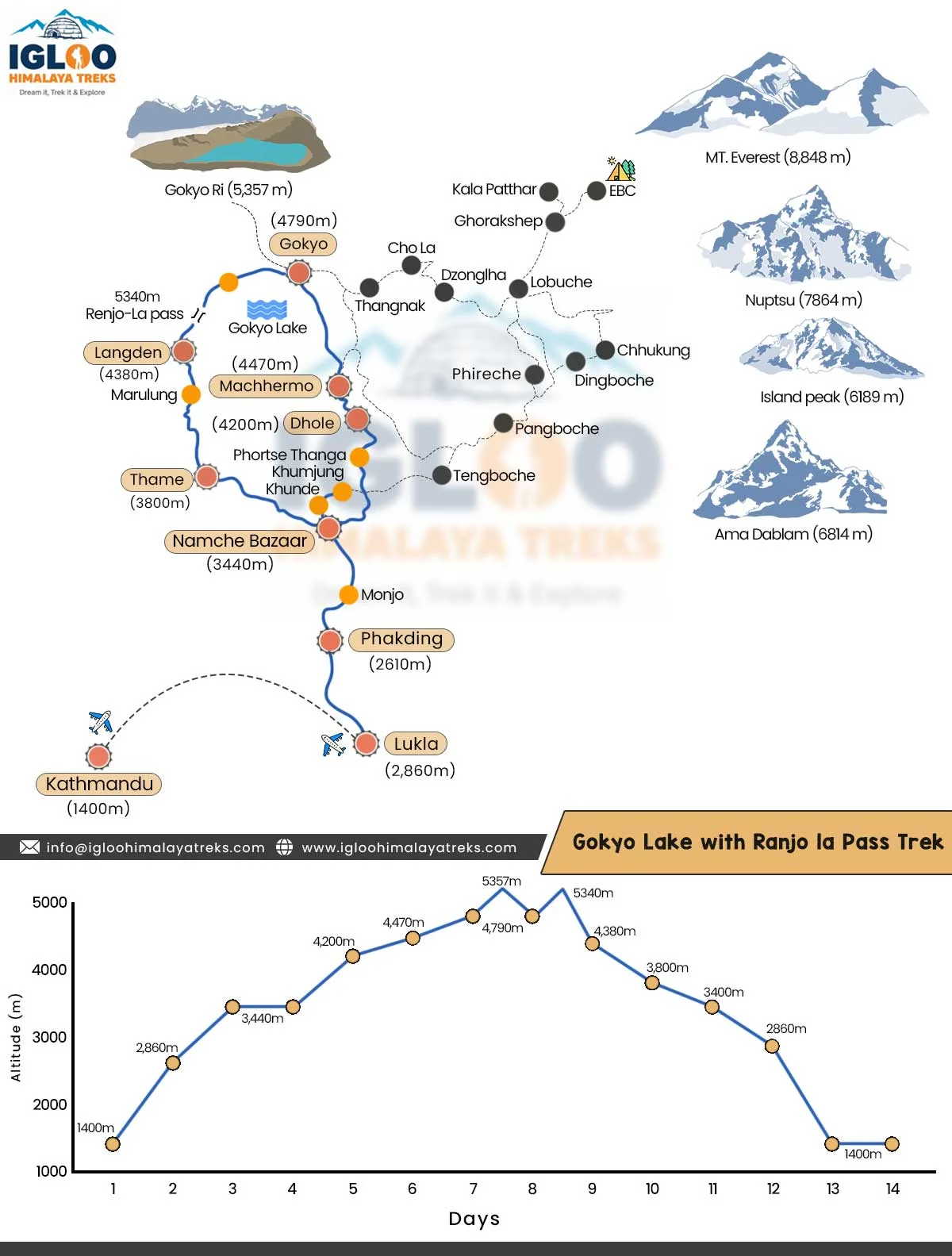
2. Elevation Profile & Hypoxia: Acclimatization Physiology from 2,846 m to 5,357 m
Altitude is the single greatest hazard on the Gokyo Lakes route. As barometric pressure drops with altitude, the percentage of oxygen in the atmosphere remains constant at 20.9%, but the effective oxygen molecules inhaled with each breath decrease drastically.
At Gokyo village (4,790 m), atmospheric pressure is approximately 56% of sea level. On the summit of Gokyo Ri (5,357 m), effective oxygen drops to roughly 51% of sea level. This forces your heart to beat faster, increases your respiration rate (hyperventilation), and makes even minor physical exertion feel like sprinting uphill.
| Location / Waypoint | Elevation (m / ft) | Effective Oxygen vs Sea Level | Physiological Impact |
|---|---|---|---|
| Lukla Airport | 2,846 m / 9,337 ft | 72% | Mild shortness of breath on stairs; safe initial baseline. |
| Namche Bazaar | 3,440 m / 11,286 ft | 67% | Mandatory rest day needed; mild morning headaches common. |
| Dole | 4,038 m / 13,248 ft | 62% | Crosses 4,000 m threshold; elevated heart rate during sleep. |
| Machhermo | 4,470 m / 14,665 ft | 58% | Noticeable loss of appetite, periodic breathing (Cheyne-Stokes). |
| Gokyo Village (Third Lake) | 4,790 m / 15,715 ft | 56% | Significant fatigue; slow, rhythmic pacing essential. |
| Gokyo Ri Summit | 5,357 m / 17,575 ft | 51% | Severe exhaustion on steep scree; 1 step per breath cycle. |
3. Trail Gradients & Vertical Challenges: The Steeps of Mong La, Dole & Gokyo Ri
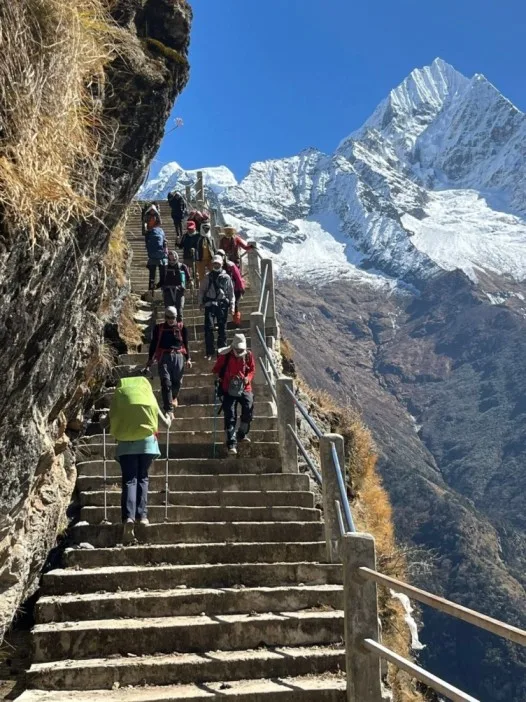
Trekkers accustomed to rolling hills or switchbacks in North America or the Alps are often shocked by the sheer steepness of Nepalese trails. Stone trails in the Himalayas were carved by centuries of yak herders and porters who preferred direct, vertical paths over long switchbacks.
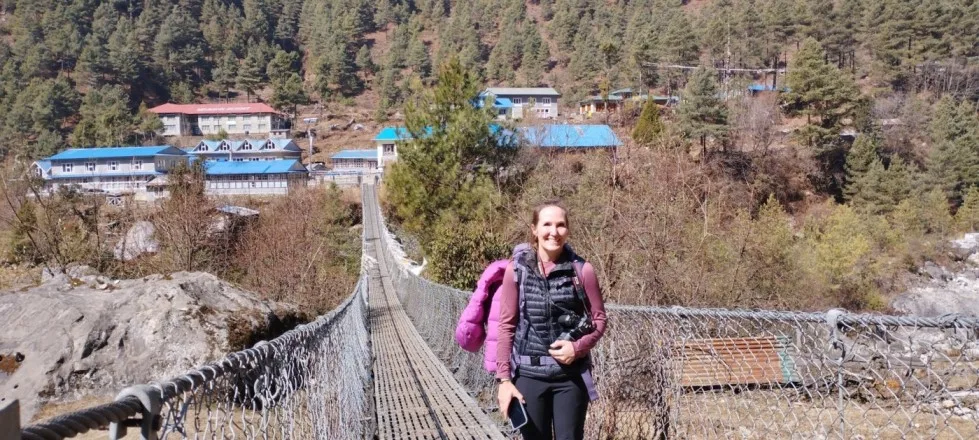
Three specific trail segments test your leg strength and cardiovascular endurance to the limit:
- The Namche Hill: An 800-meter vertical ascent over 3.2 km on Day 2. Carrying your daypack up thousands of uneven stone steps after crossing the Hillary Suspension Bridge is a brutal wake-up call for your quadriceps and calves.
- The Mong La to Phortse Tenga to Dole Rollercoaster: You climb 375 vertical meters to Mong La pass (3,975 m), then plunge straight down 300 meters on slippery gravel to the Dudh Koshi river, and immediately climb 358 vertical meters straight back up to Dole (4,038 m). This "lost altitude" is psychologically and physically taxing.
- The Gokyo Ri Summit Push: A 567-vertical-meter stair-climb on loose scree over just 1.8 kilometers, starting at 4:30 AM in sub-zero darkness. The average incline exceeds 31%, requiring intense mental determination.
4. Technical Terrain: Navigating Lateral Moraines, Loose Scree & Glacial Boulders
While the Gokyo Lakes trek is classified as a non-technical trekking peak route (no crampons, harnesses, or ropes needed for the standard out-and-back trail), the footing is far from smooth:
- Glacial Lateral Moraine: Between Machhermo and the First Lake (Longponga Tsho), the trail negotiates narrow rocky ledges alongside the terminal moraine of the Ngozumpa Glacier. Stones can shift underfoot, and trekking poles are mandatory for stability.
- Loose Scree and Gravel on Gokyo Ri: The path up Gokyo Ri consists of fine decomposed granite dust and loose pebbles. Climbing up feels like walking on sand, and descending requires careful heel-striking to avoid slipping.
- Icy Patches in Forest Shadows: Forest sections below Dole remain shaded from morning sun, causing trickling mountain runoff to freeze into treacherous "black ice" sheets across stone steps in autumn and spring mornings.
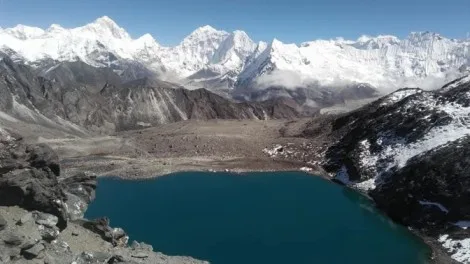
5. Physical Endurance Demands: Daily Hiking Durations, Pack Weight & Fatigue Management
Trekking consecutively for 11 to 12 days creates cumulative systemic fatigue. Even if individual days feel manageable, day after day of early morning starts, cold nights, and physical exertion depletes glycogen stores and muscular endurance.
| Trail Day | Segment | Distance | Hiking Hours | Difficulty Level |
|---|---|---|---|---|
| Day 01 | Lukla to Phakding | 7.8 km | 3.5 – 4.0 hrs | Moderate (Gentle downhill) |
| Day 02 | Phakding to Namche | 10.4 km | 5.5 – 6.5 hrs | Strenuous (Big climb) |
| Day 03 | Namche Acclimatization Loop | 5.2 km | 3.5 – 4.0 hrs | Moderate (Short hill climb) |
| Day 04 | Namche to Dole | 11.8 km | 5.5 – 6.5 hrs | Strenuous (Up-down-up) |
| Day 05 | Dole to Machhermo | 5.7 km | 3.5 – 4.5 hrs | Moderate to Demanding |
| Day 06 | Machhermo to Gokyo | 6.8 km | 4.0 – 5.0 hrs | Demanding (High altitude) |
| Day 07 | Gokyo Ri Summit & Lakes Excursion | 7.4 km | 5.5 – 6.5 hrs | Very Strenuous (Peak exertion) |
| Day 08 | Gokyo to Dole | 12.5 km | 5.0 – 6.0 hrs | Demanding (Long descent) |
| Day 09 | Dole to Namche | 11.8 km | 4.5 – 5.5 hrs | Moderate (Net downhill) |
| Day 10 | Namche to Phakding | 10.4 km | 4.5 – 5.0 hrs | Moderate (Steep downhill) |
| Day 11 | Phakding to Lukla | 7.8 km | 3.5 – 4.0 hrs | Moderate (Uphill finish) |
6. Extreme Alpine Weather: Sub-Zero Teahouses, Cold Winds & Frostbite Prevention
The cold in the Gokyo Valley is dry, penetrating, and unyielding. Unlike Western ski resorts where indoor spaces are centrally heated, Himalayan teahouses have uninsulated plywood bedrooms with zero heating.
The only heated space in the entire lodge is the central dining hall, where a cast-iron stove is lit with dried yak dung for approximately three hours in the evening (from 5:00 PM to 8:30 PM). By 9:00 PM, the stove dies out, and the indoor room temperature drops to match the outdoor freeze.
Because the Gokyo Valley runs north-to-south directly beneath the massive 8,188-meter wall of Cho Oyu, cold katabatic winds funnel down the Ngozumpa Glacier every afternoon. Wind chill temperatures on the shores of Third Lake can plunge to -15°C even when the daytime sun is shining. Always carry a windproof Gore-Tex shell and fleece buff in your daypack.
7. Acute Mountain Sickness (AMS), HAPE & HACE: Warning Signs & Descent Protocols
Acute Mountain Sickness (AMS) affects roughly 40% to 50% of trekkers ascending above Namche Bazaar to some degree. Mild symptoms include throbbing frontal headaches, mild nausea, dizziness, insomnia, and loss of appetite.
Our guides enforce the Three Golden Rules of High-Altitude Safety:
- Never ascend with symptoms of AMS: If you wake up with a persistent headache or nausea, remain at your current altitude (e.g., in Dole or Machhermo) for an extra rest day.
- If symptoms worsen, descend immediately: Losing just 400 to 600 vertical meters (e.g., descending from Machhermo to Dole or Phortse) rapidly reverses hypoxia and saves lives.
- Recognize HAPE and HACE immediately: High Altitude Pulmonary Edema (fluid in the lungs, manifested by wet rattling cough, extreme breathlessness at rest, blue lips) and High Altitude Cerebral Edema (brain swelling, manifested by loss of coordination/ataxia, confusion, hallucinations) are medical emergencies requiring immediate descent and emergency helicopter evacuation.
8. Difficulty Comparison: Gokyo Lakes vs Everest Base Camp (Which is Harder?)
Trekkers constantly debate whether the Gokyo Lakes trek is harder than the classic Everest Base Camp (EBC) route. The reality is nuanced: each presents different types of challenges:
| Difficulty Dimension | Classic Everest Base Camp (EBC) | Gokyo Lakes & Gokyo Ri | Which Route is Harder? |
|---|---|---|---|
| Total Trail Distance | 130 km round-trip | 92 km round-trip | EBC is harder (38 km longer) |
| Maximum Sleeping Altitude | 5,164 m (Gorak Shep) | 4,790 m (Gokyo Village) | EBC is harder (Sleeps 374 m higher) |
| Maximum Viewpoint Height | 5,545 m (Kala Patthar) | 5,357 m (Gokyo Ri) | EBC is slightly higher (+188 m) |
| Trail Gradients & Undulation | Gradual river valleys after Namche | Steep rollercoaster (Mong La / Dole) | Gokyo is harder (Steeper climbs) |
| Trail Crowds & Congestion | High (Yak trains, dusty bottlenecks) | Low (Peaceful, tranquil trails) | EBC is more stressful |
| Gokyo Ri vs Kala Patthar Climb | Steep switchbacks from Gorak Shep | Sustained 31% loose scree climb | Gokyo Ri is physically steeper |
The Verdict: Gokyo Lakes is physically steeper on a day-to-day basis, but Everest Base Camp is slightly harder overall due to sleeping at the extreme altitude of Gorak Shep (5,164 m) and walking 38 additional kilometers.
9. High-Pass Difficulty Add-ons: Cho La (Glacier Crossing) & Renjo La (Loose Scree)
If you choose to link Gokyo with EBC or loop through Thame, the difficulty rating jumps from Grade 4 (Challenging) to Grade 5 (Demanding / Alpine Expedition):
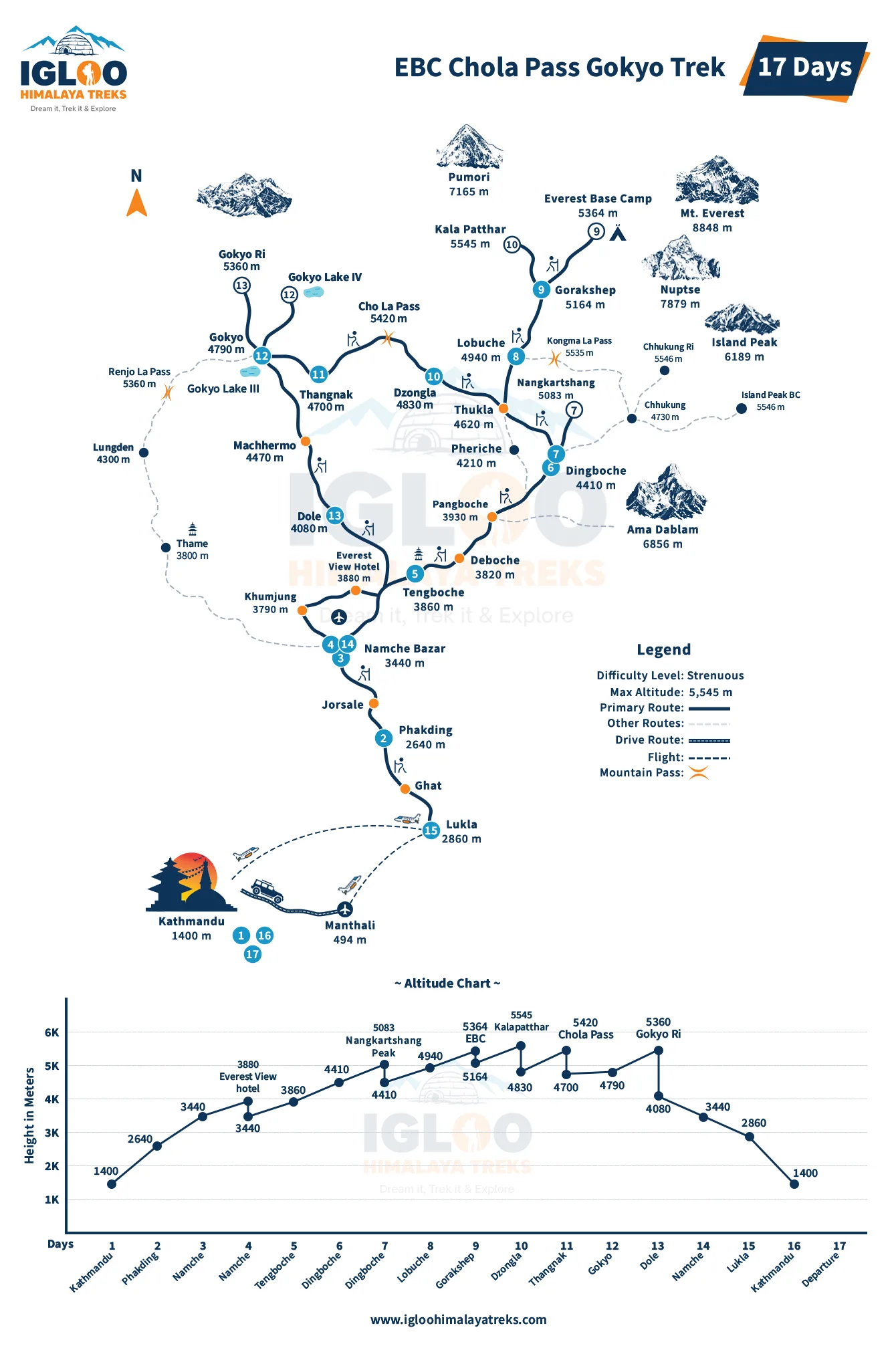
- Cho La Pass (5,420 m): Involves an early 5:00 AM start from Thagnak, scrambling up loose boulder fields, scaling a steep headwall with icy chains, crossing a 400-meter crevassed glacier shelf requiring microspikes, and descending a slippery scree chute into Dzongla. Requires 7 to 9 hours of intense concentration.
- Renjo La Pass (5,360 m): Features a relentless 3.5-hour stone staircase climb from Gokyo Third Lake, followed by a loose scree descent that places heavy shearing forces on knees and ankles before reaching Lungden.
10. Psychological Demands: Coping with Basic Teahouses, Hygiene & High-Altitude Insomnia
Physical fitness is only half the battle. High-altitude trekking in the remote Gokyo Valley requires significant mental toughness to cope with Spartan living conditions:
- Squat Toilets and Frozen Plumbing: Above Dole, western-style flush toilets freeze solid. You must be mentally comfortable using traditional Asian squat toilets and carrying your own toilet paper and hand sanitizer.
- High-Altitude Insomnia: At 4,500 meters, Cheyne-Stokes respiration (periodic breathing cycles where your body naturally pauses breathing during deep sleep, causing you to wake gasping for air) disrupts sleep quality. Remaining calm and knowing this is a normal physiological response prevents anxiety.
- Sensory Deprivation & Cold: Stripping down into cold sleeping bags, washing your face with freezing water, and spending weeks without a hot shower demands disciplined mental resolve.
11. 12-Week Pre-Trek Training Roadmap: Cardiovascular, Stair Incline & Leg Strength
To arrive in Nepal physically prepared to thoroughly enjoy—rather than merely endure—the Gokyo Lakes trek, follow this progressive 12-week conditioning plan:
| Phase | Weeks | Cardiovascular Focus | Strength & Resistance | Weekend Incline Hikes |
|---|---|---|---|---|
| Base Building | Weeks 1 – 4 | 3x weekly Zone 2 cardio (Jogging, cycling) 30–45 min | Bodyweight squats, lunges, calf raises, core planks | 5–8 km hike with empty daypack (300 m gain) |
| Strength & Load | Weeks 5 – 8 | Stairmaster or inclined treadmill (12% grade) 45 min | Weighted step-ups, goblet squats, Romanian deadlifts | 10–14 km hike carrying 6 kg pack (600 m gain) |
| Peak Endurance | Weeks 9 – 11 | HIIT cardio intervals 1x/wk + 2x Zone 2 cardio 60 min | Leg press, eccentric heel drops, core stability | 14–18 km steep mountain hike carrying 8 kg pack (800 m gain) |
| Tapering | Week 12 | Light 20-min easy jogs, mobility stretching | Light stretching, foam rolling | Rest, hydration, and mental preparation |
12. Essential Safety Gear: Footwear Stability, Microspikes & Trekking Poles
Your gear is your direct line of defense against physical fatigue and trail injuries:
- Supportive Mid/High-Cut Hiking Boots: Flexible running shoes or trail runners lack adequate lateral ankle support for shifting moraine rocks and will cause ankle rolls.
- Dual Adjustable Trekking Poles: Essential for reducing knee cartilage wear by up to 25% during the 4,200-meter cumulative descents.
- Microspikes (Yaktrax or Kahtoola style): Lightweight elastomeric chain traction spikes that slip over boots in 10 seconds. Essential for icy shaded paths around Dole and Mong La.
- Knee Braces or K-Tape: For trekkers prone to patellar tendonitis ("runner's knee") on long descents.
13. Emergency Rescue Protocols: Helicopter Evacuation, Oximeters & Wilderness First Aid
When trekking in the Gokyo Valley, having robust emergency response protocols is non-negotiable:
- Daily Health Audits: Our certified guides carry medical pulse oximeters and conduct SpO2 blood-oxygen saturation checks every morning and evening, logging your scores on the Lake Louise AMS score sheet.
- First Aid Kit & Medications: Guides carry Diamox (Acetazolamide) for acclimatization support, Ibuprofen for altitude headaches, Dexamethasone for emergency cerebral edema stabilization, and Nifedipine for pulmonary emergencies.
- Satellite SOS Communication: Guides carry Garmin inReach satellite communicators. If a trekker exhibits symptoms of severe HAPE or HACE, emergency helicopter evacuation can be dispatched directly to the Gokyo helipad within 45 to 90 minutes during clear weather.
Frequently Asked Questions: Gokyo Lakes Trek Difficulty
Select a category below to explore expert answers to the most common questions travelers ask about Gokyo Lakes Trek Difficulty:
Difficulty & Fitness
Ready to Experience the Himalayas?
Whether you are preparing for high-altitude trekking, cultural circuits, or alpine summit expeditions, start planning a bespoke journey tailored to your fitness, travel season, and style.